TSA Liquid Allowance: 3-1-1 Rule, 3.4 oz Limit & Exceptions
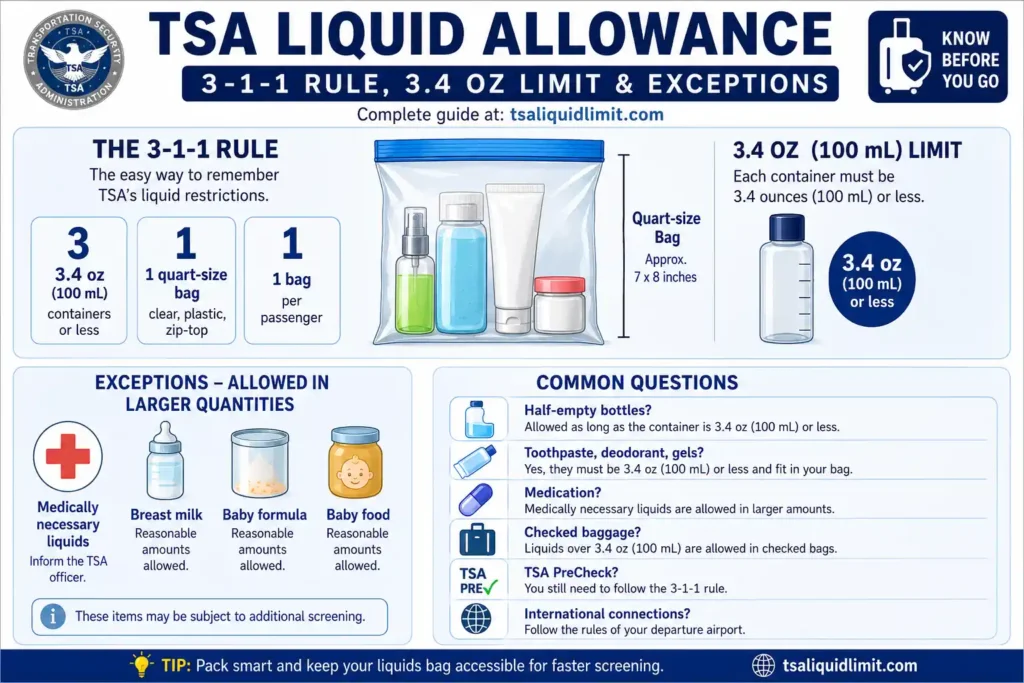
The standard TSA liquid allowance for carry-on bags is 3.4 ounces (100 mL) or less per container. Your qualifying liquids, gels, aerosols, creams, and pastes should fit in one quart-sized, clear, plastic, zip-top bag, with one bag allowed per passenger. Some items, including medically necessary liquids, breast milk, baby formula, and certain baby foods, can be allowed in larger quantities. TSA Liquid Limit
The 3-1-1 rule is easy to remember, but questions often come up around half-empty bottles, toothpaste, deodorant, medication, checked baggage, TSA PreCheck, and international connections.
What Is the TSA Liquid Allowance?
The TSA liquid allowance refers to the restrictions that apply to liquids and similar products in carry-on baggage when you go through a TSA security checkpoint.
For standard carry-on liquids, the basic rule is:
| Rule | Standard allowance |
|---|---|
| Each container | 3.4 oz (100 mL) or less |
| Liquids bag | 1 quart-sized, clear, plastic, zip-top bag |
| Bags per passenger | 1 |
The rule applies to more than ordinary liquids. TSA includes aerosols, gels, creams, and pastes in the 3-1-1 rule.
The standard 3-1-1 rule is mainly a carry-on screening requirement. Checked baggage follows different rules, although some liquids, aerosols, and toiletries remain subject to restrictions.
If you’re unsure about a particular product, use TSA’s official What Can I Bring?
What Is the TSA 3-1-1 Liquids Rule?
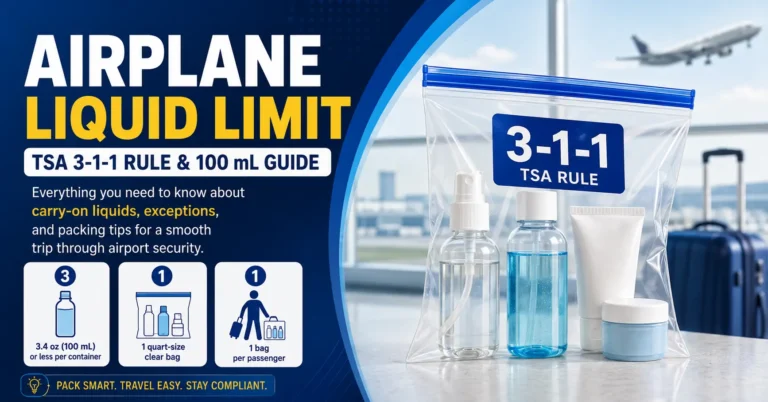
The name comes from three simple parts: 3.4 ounces, 1 quart-sized bag, and 1 bag per passenger.
What Does the “3” Mean?
Each standard carry-on liquid container must be 3.4 ounces (100 mL) or smaller.
This applies to qualifying liquids, gels, aerosols, creams, and pastes. Examples include shampoo, lotion, toothpaste, perfume, and many liquid or gel products.
What Does the First “1” Mean?
Your standard carry-on liquids should fit into one quart-sized, clear, plastic, zip-top bag.
TSA recommends keeping the bag accessible because you may need to remove it during standard security screening. TSA Travel Checklist
What Does the Second “1” Mean?
The second “1” means one quart-sized bag per passenger.
This does not mean you can bring only one 3.4-ounce container. You can carry multiple qualifying containers if they comply with the size requirement and fit in the single required bag.
Does the Amount Left in the Bottle Matter?
For standard carry-on liquids, use a container that is 3.4 ounces (100 mL) or smaller.
For example, don’t rely on a large bottle simply because it is partly empty. A 6-ounce bottle containing only 2 ounces should not be treated as a standard 3.4-ounce travel container.
If you only need a small amount of a product, move it into an appropriately sized travel container.
What Counts as a Liquid Under TSA Rules?
TSA’s liquid rule covers more than water and other drinks.
The 3-1-1 category includes:
- Liquids
- Gels
- Aerosols
- Creams
- Pastes
That means everyday products such as shampoo, conditioner, lotion, toothpaste, perfume, and liquid makeup can fall under the rule. TSA Liquids Rule
The form of a product matters. A solid product can be treated differently from a liquid, gel, cream, paste, or aerosol version of the same type of item.
For a specific product, check TSA’s item database rather than assuming that all versions are treated the same way.
Common Toiletries That May Be Subject to the Liquid Rule
Common examples include:
- Shampoo
- Conditioner
- Liquid soap
- Lotion
- Liquid foundation
- Mascara
- Lip gloss
- Perfume
- Cologne
- Toothpaste
- Hand sanitizer
- Contact lens solution
The exact treatment can depend on the product and how it is packaged, so TSA’s What Can I Bring?
What About Food?
Some foods are treated as liquids, gels, or spreadable substances for checkpoint screening.
TSA’s item-specific guidance includes restrictions for liquid and gel foods. A standard carry-on liquid or gel food item larger than 3.4 ounces generally cannot pass through the security checkpoint unless it qualifies for an exception.
Examples can include:
- Gravy
- Soup
- Sauces
- Some creamy foods
- Liquid chocolate
- Other spreadable or gel-like foods
Because food products vary, check the specific item in TSA’s database before traveling.
TSA Liquid Allowance for Common Travel Items
The following table gives a quick starting point for common products.
| Item | Standard carry-on treatment |
|---|---|
| Shampoo | 3.4 oz / 100 mL or less |
| Conditioner | 3.4 oz / 100 mL or less |
| Lotion | 3.4 oz / 100 mL or less |
| Liquid soap | 3.4 oz / 100 mL or less |
| Toothpaste | 3.4 oz / 100 mL or less |
| Perfume | 3.4 oz / 100 mL or less |
| Cologne | 3.4 oz / 100 mL or less |
| Hand sanitizer | 3.4 oz / 100 mL or less under the standard rule |
| Liquid makeup | 3.4 oz / 100 mL or less |
| Liquid or gel food | 3.4 oz / 100 mL or less under the standard rule |
| Bar soap | Generally not treated as a liquid |
This is a quick-reference guide, not a replacement for TSA’s item-specific rules. Some products have additional requirements or exceptions.
How Much Liquid Can You Bring in a Carry-On?
For standard carry-on liquids, remember:
3.4 oz (100 mL) or less per container + one quart-sized bag + one bag per passenger.
Can You Bring Multiple 3.4-Ounce Bottles?
Yes. The 3-1-1 rule does not limit you to one 3.4-ounce bottle. You can carry multiple compliant containers, provided they fit in your single quart-sized bag.
There is no useful universal bottle count because containers come in different shapes and sizes. The practical limit is whether your qualifying containers fit in the required bag.
Is There a Total Ounce Limit?
The standard TSA 3-1-1 rule is not expressed as one total-ounce number for all of your carry-on liquids.
Instead, it combines:
- 3.4 ounces (100 mL) or less per container
- One quart-sized bag
- One bag per passenger
So calculating a fixed number of bottles can be misleading.
Can You Bring a Half-Empty Larger Bottle?
For standard carry-on liquids, don’t rely on a partially empty oversized container.
If you have a larger bottle, transfer the amount you need into a compliant travel-size container when appropriate, or place the original container in checked baggage if the specific product is permitted there.
TSA Liquid Allowance for Checked Baggage
The standard 3.4-ounce carry-on rule is not the same rule used for checked baggage.
That does not mean checked baggage has no restrictions on liquids.
Certain products, especially aerosols, toiletries, and other regulated items, can have separate limits under applicable aviation rules. TSA’s item database provides specific guidance for many products and may refer travelers to FAA requirements for certain checked-baggage items.
Carry-On vs. Checked Baggage
| Carry-on | Checked baggage | |
|---|---|---|
| Standard 3.4 oz rule | Applies to qualifying liquids | Not the standard rule |
| Quart-sized liquids bag | Required for standard liquids | Not required |
| Large shampoo bottle | Generally not permitted as a standard carry-on liquid | May be allowed |
| Aerosols | Restrictions apply | Restrictions apply |
| Special products | Check TSA database | Check TSA/FAA requirements |
Before packing a large amount of any liquid or aerosol in checked baggage, check the specific product.
Checked baggage does not mean unlimited liquids.
TSA Liquid Rule Exceptions
Some items can exceed the standard 3.4-ounce limit.
Medications
TSA allows medically necessary liquids, medications, and creams in reasonable quantities for the trip, including quantities greater than 3.4 ounces (100 mL).
These items do not have to fit inside the standard quart-sized liquids bag. You should tell the TSA officer about medically necessary liquids at the beginning of screening. They may require separate screening.
Breast Milk
Breast milk can exceed the standard 3.4-ounce limit.
TSA says breast milk does not have to fit in the quart-sized bag. Tell the TSA officer that you are carrying breast milk and follow the instructions for separate screening.
Baby Formula
Baby formula can also be carried in quantities greater than 3.4 ounces.
TSA’s current guidance includes formula, breast milk, toddler drinks, and certain baby or toddler foods among items that can exceed the standard liquid limit and do not have to fit in the quart-sized bag.
You should tell the TSA officer about these items at the beginning of screening.
TSA also states that a child or infant does not have to be present or traveling with you for you to bring breast milk, formula, and related supplies. TSA Liquid Exceptions
Toddler Drinks and Baby Food
TSA allows certain toddler drinks and baby/toddler foods to exceed the standard 3.4-ounce limit.
This includes certain puree-style baby foods and drinks. Because TSA applies item-specific guidance, check the official database when you are unsure about a particular product.
Ice Packs and Cooling Accessories
Cooling accessories used with breast milk or formula can qualify for the relevant exception.
For ordinary frozen liquids and gel packs, the state of the item matters. TSA’s guidance states that frozen liquid items can pass through when they are frozen solid. If they are partially melted, slushy, or have liquid at the bottom, the standard liquid requirements may apply.
TSA PreCheck Liquid Rules
TSA PreCheck makes some parts of security screening easier, but it does not remove the standard 3-1-1 liquid rule.
The important difference is what happens at the checkpoint.
TSA’s current checkpoint guidance says eligible PreCheck passengers can leave their 3-1-1 liquids in their carry-on bags during screening.
Does TSA PreCheck Change the 3.4-Ounce Limit?
No. TSA PreCheck does not turn an oversized liquid container into a permitted standard carry-on item.
The benefit is that eligible PreCheck travelers generally do not need to remove their compliant 3-1-1 liquids bag during screening.
TSA Liquid Rules for International Travel
If you are departing from a U.S. airport, TSA rules apply at the U.S. security checkpoint.
International travel can involve additional security requirements, particularly if you have a connection and must go through security again.
TSA does not establish the security rules for every airport outside the United States.
Before an international trip, check:
- Your U.S. departure airport
- Your connecting airport
- The relevant airport or national security authority
- Your airline when special circumstances apply
This matters when you purchase liquids after passing through security and then have another security screening during your journey.
What About Duty-Free Liquids?
Duty-free liquids can receive special treatment, but travelers should not assume that a purchase made after security will automatically be accepted at every later checkpoint.
This is particularly important when you have an international connection.
If your itinerary includes another security screening, check the requirements of that airport before traveling. Keep the retailer’s packaging and receipt with the purchase when applicable, and follow any instructions provided for security screening.
How to Pack Liquids for TSA Security
A little preparation can save time at the checkpoint.
1. Check every container
Look at the container size before packing it. Don’t assume a partly empty larger bottle qualifies as a travel-size container.
2. Separate your standard liquids
Put qualifying liquids, gels, creams, pastes, and aerosols together so they can be placed in the required quart-sized bag.
3. Use one clear quart-sized bag
The standard rule allows one quart-sized, clear, plastic, zip-top bag per passenger.
4. Keep the bag accessible
If you are going through standard screening, keep the liquids bag somewhere easy to reach. TSA’s travel checklist recommends making the bag accessible.
5. Keep exceptions easy to identify
Medication, breast milk, formula, and other qualifying exception items should be easy to remove and declare at the checkpoint.
6. Check unusual products before leaving home
If you’re unsure about an item, search TSA’s What Can I Bring?
That’s more reliable than assuming that a product follows the standard rule simply because it looks similar to another item. TSA What Can I Bring?
Common TSA Liquid Mistakes to Avoid
Bringing a half-empty oversized bottle
The amount remaining inside a larger container should not be used as a substitute for a compliant travel-size container.
Forgetting that toothpaste is a paste
The rule includes pastes, not just liquids. Toothpaste is a common example.
Taking a full water bottle through security
A filled water bottle is subject to the liquid rule. TSA’s item database allows empty drink containers, which can then be filled after the checkpoint.
Putting medical liquids in the standard liquids bag
Qualifying medically necessary liquids can be handled as an exception and do not have to fit in the standard quart-sized bag. Declare them to the TSA officer.
Assuming TSA PreCheck removes the liquid limit
PreCheck changes the screening process, not the underlying standard liquid allowance.
Assuming checked baggage has no liquid restrictions
Checked baggage follows different rules, but certain liquids and aerosols remain restricted. Check the specific product before packing it.
Frequently Asked Questions
How many ounces of liquid can I bring on a plane?
For standard carry-on liquids, each container must be 3.4 ounces (100 mL) or less. Qualifying containers should fit into one quart-sized, clear, plastic, zip-top bag, with one bag allowed per passenger. TSA 3-1-1 guidance
Can I bring 4 oz of liquid through TSA?
A standard 4-ounce container is larger than the 3.4-ounce / 100 mL limit for standard carry-on liquids. Unless the item qualifies for an exception, it should not be packed as a standard carry-on liquid.
Does toothpaste count as a liquid for TSA?
Toothpaste is treated as a paste, so standard carry-on quantities are subject to the 3-1-1 rule.
Is deodorant considered a liquid for TSA?
It depends on the form. Solid deodorant is treated differently from aerosol or liquid/gel deodorant.
Can I bring multiple 3.4 oz bottles?
Yes. You are not limited to one 3.4-ounce container. Multiple qualifying containers can be carried as long as they fit in your single quart-sized bag.
Can I bring a 6 oz bottle that is half empty?
For a standard carry-on liquid, use a container that is 3.4 ounces (100 mL) or smaller. Don’t rely on the amount remaining inside a larger container.
Does TSA PreCheck change the liquid limit?
No. TSA PreCheck allows eligible passengers to leave compliant 3-1-1 liquids in their carry-on during screening, but it does not remove the standard liquid restrictions.
Can I bring medication over 3.4 oz?
Medically necessary liquid medication can exceed 3.4 ounces / 100 mL in reasonable quantities for the trip. Declare it at the checkpoint and follow TSA’s screening instructions.
Can I bring breast milk over 3.4 oz?
Yes. TSA allows breast milk in quantities greater than 3.4 ounces. It does not need to fit in the standard quart-sized bag, but you should declare it and follow the screening procedure.
Can I bring baby formula over 3.4 oz?
Yes. TSA allows formula and certain baby or toddler drinks and foods in quantities greater than 3.4 ounces. These items do not have to fit in the standard quart-sized liquids bag.
Can I bring full-size shampoo in checked baggage?
The standard 3.4-ounce carry-on rule does not apply in the same way to checked baggage. However, other restrictions can apply to liquids and aerosols, so check the specific product before packing a large container.
Are TSA liquid rules different for international flights?
TSA rules apply at U.S. TSA security checkpoints. If your international itinerary involves security screening in another country, that airport or country’s requirements may also apply.
TSA Liquid Allowance Quick Checklist
Before leaving for the airport:
- Standard carry-on liquid containers are 3.4 oz / 100 mL or less
- Qualifying liquids fit in one quart-sized, clear, plastic, zip-top bag
- You have one standard liquids bag per passenger
- Medical liquids are separated and ready to declare
- Breast milk, formula, and qualifying baby items are easy to identify
- Larger toiletries are packed appropriately for checked baggage when permitted
- Unusual products have been checked in TSA’s official What Can I Bring?
- Your liquids bag is easy to access before standard security screening
Conclusion
The standard TSA liquid allowance for carry-on baggage is simple: 3.4 ounces (100 mL) or less per container, one quart-sized clear plastic bag, and one bag per passenger.
The part that causes confusion is everything around the basic rule. Medications, breast milk, formula, baby food, frozen items, aerosols, checked baggage, TSA PreCheck, and international connections can have different requirements. TSA Liquid Exceptions