TSA Liquid Limit: The 3-1-1 TSA Liquid Rules Explained
| 3 |
| 3.4 oz (100 ml) per container |
| 1 |
| 1 quart-size clear bag |
| 1 |
| 1 bag per traveler |
The TSA liquid limit has not changed in 2026. Travelers can still carry liquids, gels, aerosols, creams, and pastes in containers of up to 3.4 ounces (100 ml), with all containers fitting inside one quart-size, clear, zip-top bag under the TSA 3-1-1 Rule. This policy applies to all passengers traveling on domestic and international flights departing from U.S. airports. Although some airports are using advanced CT scanners, travelers must continue following the standard liquid rule unless the airport provides official TSA-approved guidance. So, what’s actually new in 2026?
Travel Tips: 3-1-1 TSA Liquid Rules
You are allowed to bring a quart-sized bag of liquids, aerosols, gels, creams, and pastes through the checkpoint. These are limited to 3.4 ounces (100 milliliters) or less per item. This is also known as the 3-1-1 liquids Rule.
- Any liquid
- aerosol
- gel & cream
What Is the TSA 3-1-1 Rule?
The TSA 3-1-1 rule is the Transportation Security Administration’s standard policy governing liquids, aerosols, gels, creams, and pastes in carry-on bags. Introduced in 2006 following a foiled liquid explosive plot, the rule has been the foundation of airport security screening in the United States for nearly two decades.
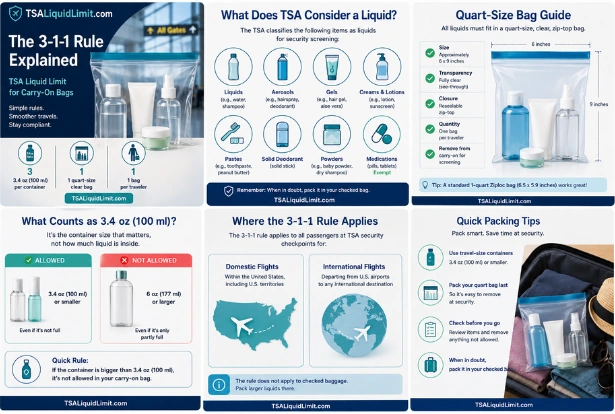
Each number in “3-1-1” stands for a specific requirement:
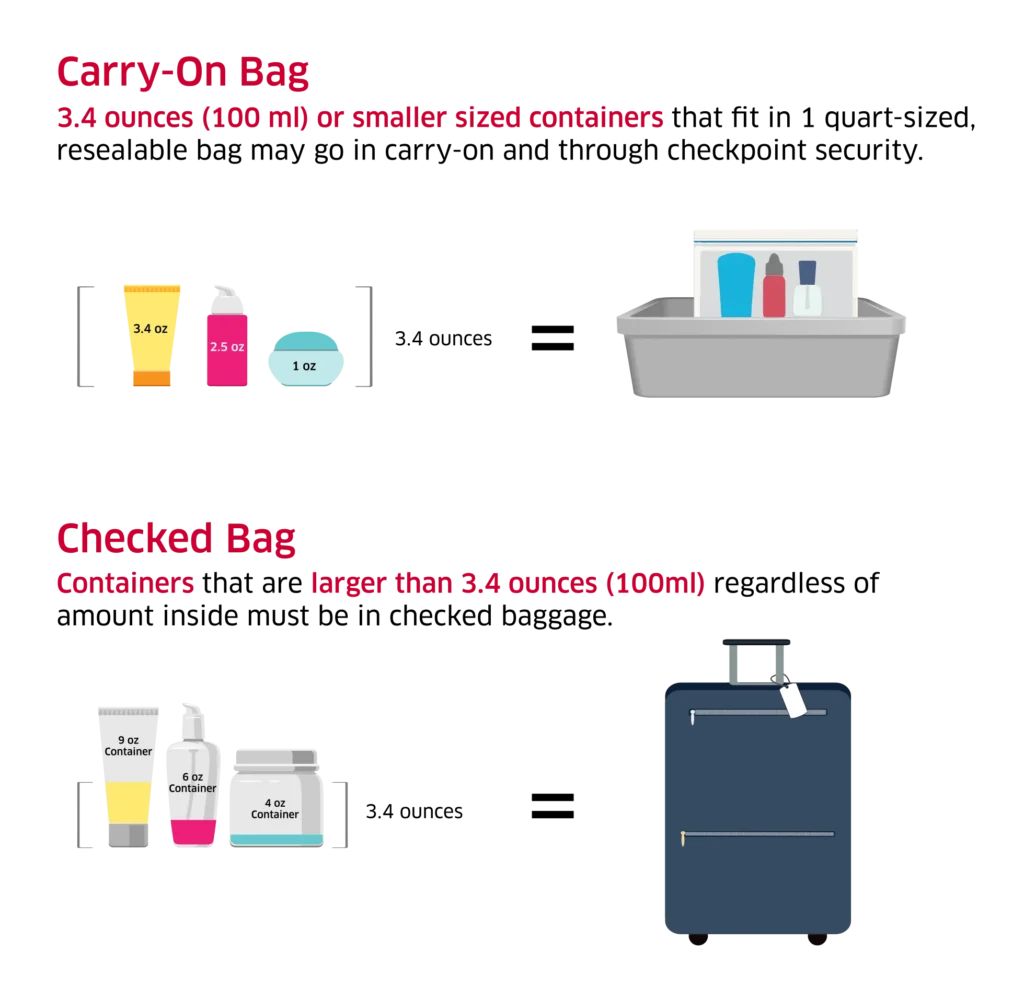
- 3 – Each individual container of liquid must hold no more than 3.4 fl oz (100 ml). The container size matters, not how full it is. Even a 6 oz bottle that is half full does not comply – the bottle itself cannot exceed 3.4 oz.
- 1 – All compliant containers must fit comfortably inside one quart-size (approximately 6 × 9 inches), clear, resealable plastic bag. TSA does not require a specific brand; any transparent zip-top bag of that approximate size qualifies.
- 1 – Each passenger is allowed only one such bag. It must be removed from your carry-on and placed in a bin separately during the security screening process.
Expert Tip: The 3-1-1 rule applies to the container size – not the amount of liquid inside. A 4 oz bottle that is only 10% full will still be confiscated. Always decant into travel-size containers of 3.4 oz or less.
TSA Carry-On Liquid Limit at a Glance
If you only remember one thing about the TSA carry-on liquid limit, remember this: container size is what’s measured, not the amount left inside. Here is a quick reference for the current TSA liquid limits:
- TSA liquid size limit: 3.4 fl oz (100 ml) per individual container – no exceptions for partially-full bottles
- Bag requirement: one clear, quart-size, resealable bag per traveler
- Liquid requirements for TSA apply equally to liquids, gels, aerosols, creams, and pastes
- Checked baggage: the 3.4 oz limit does not apply – full-size containers are fine (aerosols capped at 18 oz per container)
Why Does TSA Enforce This Rule?
The rule exists because certain liquid explosive precursors cannot be reliably detected by X-ray screening at the volumes permitted. Limiting individual containers to 3.4 oz (100 ml) restricts the amount of any single substance that could pass through a checkpoint, while the clear bag requirement allows security officers to conduct rapid visual screening without opening every container.
Does the 3-1-1 Rule Apply to Checked Baggage?
No. The TSA liquid limit of 3.4 oz applies only to carry-on bags. For checked luggage, you may generally bring full-size bottles of shampoo, conditioner, lotion, and similar personal care items. Aerosols in checked bags are permitted up to 18 oz per container and 70 oz total, but flammable aerosols (such as spray paint) are prohibited regardless of placement.
Has the TSA Liquid Limit Changed in 2026?
No – the core TSA liquid limit has not changed nationwide. The 3.4 oz (100 ml) per container / 1 quart bag / 1 bag per traveler rule is still the federal standard at every U.S. airport in 2026. What has changed is the screening technology at some checkpoints, and that’s the source of most of the confusion travelers are searching about right now.
Why Everyone Thinks the Rule Changed
In July 2025, Homeland Security Secretary Kristi Noem said TSA was “reevaluating the liquids policy” and hinted that “the next big announcement may be on the size of liquids allowed.” That single comment spread quickly and led many travelers to believe the 3-1-1 rule was being scrapped. As of 2026, no such nationwide policy change has been announced or implemented – the standard TSA liquid rules remain fully enforced at the vast majority of checkpoints.
CT Scanners: What Actually Changed
TSA has been rolling out Computed Tomography (CT) scanners – which create a detailed 3D image of your bag instead of a flat 2D X-ray – at major hubs including Atlanta (ATL), JFK, LAX, O’Hare (ORD), and Dallas-Fort Worth (DFW), with expansion continuing through 2026. At a CT-equipped lane, you typically don’t need to remove your quart bag or laptop from your carry-on – screening is faster and less hands-on. But the container size limit itself hasn’t changed. A CT lane still enforces the 3.4 oz per container rule; it just changes how the bag is screened, not how much liquid you’re allowed to carry.
Not every lane at a CT-equipped airport actually has a CT scanner yet, and smaller regional airports may not have any. The safest approach: pack as if standard 3-1-1 applies everywhere, and treat a CT lane as a bonus convenience rather than a rule change.
The 11 Exempt Item Categories at CT-Equipped Checkpoints
At airports with CT scanners, TSA has expanded the list of items exempt from the standard 3.4 oz limit. These generally include:
- Baby formula and breast milk (any quantity)
- Toddler drinks and baby food
- Liquid medications, prescription and over-the-counter, with documentation
- Contact lens solution in reasonable quantities
- Insulin and other injectable medical liquids
- Liquid nutritional and dietary supplements for medical use
- Duty-free liquids in a sealed, tamper-evident bag with receipt
- Ice packs and gel packs, if frozen completely solid
- Frozen breast milk and baby food (thawed/slushy items are treated as liquids)
- Certain dialysis-related liquids
- Other medically necessary liquids, declared at the checkpoint
Expert Tip: These exemptions apply at CT-equipped checkpoints specifically – they are not yet a universal nationwide policy. Always declare exempt liquids to the officer regardless of which scanner your airport uses.
What About the 12 oz Hand Sanitizer Exemption?
You may still see outdated articles claiming hand sanitizer is allowed up to 12 oz. That was a temporary COVID-19 era exemption. According to TSA’s own current guidance, hand sanitizer is back under the standard rule: 3.4 oz (100 ml) per container, inside your quart bag. If you see a source claiming otherwise in 2026, it’s referencing the expired pandemic-era policy.
What Does TSA Consider a Liquid?
The TSA’s definition of “liquid” is broader than most travelers expect. The agency classifies the following as liquids for screening purposes:
| Category | Examples | Rule Applies? |
| Liquids | Water, juice, shampoo, conditioner, mouthwash | ✅ Yes — 3.4 oz limit, in bag |
| Aerosols | Hairspray, spray deodorant, spray sunscreen, dry shampoo | ✅ Yes — 3.4 oz limit, in bag |
| Gels | Hair gel, aloe vera gel, contact lens solution | ✅ Yes — 3.4 oz limit, in bag |
| Creams & Lotions | Hand cream, sunscreen lotion, face moisturizer | ✅ Yes — 3.4 oz limit, in bag |
| Pastes | Toothpaste, peanut butter, similar spreadables | ✅ Yes — 3.4 oz limit, in bag |
| Solid Deodorant | Stick deodorant, solid bar soap | ✅ No — solids are exempt |
| Powder | Baby powder, dry shampoo powder | ✅ No — under 12 oz generally exempt |
| Pills & Solid Medication | Tablets, capsules, vitamins | ✅ No — fully exempt |
Expert Tip: The “peanut butter rule” is real. TSA officers follow the Spreadable Test – if you can spread it, smear it, or pour it, it counts as a liquid. This is why peanut butter, hummus, and similar foods are subject to the 3.4 oz limit in carry-on bags.
What Size Bag Do You Need for TSA Liquids?
TSA requires that all carry-on liquids fit inside a quart-size, clear, zip-top bag. Here is exactly what that means:
| Requirement | Details |
| Size | Approximately 6 × 9 inches (1 quart volume). Exact dimensions are not regulated — the bag simply must be quart-size. |
| Transparency | Fully clear/transparent so TSA officers can see contents without opening the bag. |
| Closure | Must be resealable — zip-top or press-seal style. Tied bags do not comply. |
| Quantity | One bag per traveler. Additional bags will be rejected at the checkpoint. |
| Placement | Must be removed from your carry-on and placed in a separate screening bin. |
| Brand | No brand requirement. Any clear quart-size zip bag (Ziploc, store brand, travel pouch) is accepted. |
| Reuse | The same bag can be used for multiple trips. Replace if the seal is damaged. |
Expert Tip: A standard 1-quart Ziploc freezer bag (6.5 × 5.9 inches) is slightly smaller than the ideal quart-size travel bag but is widely accepted at checkpoints. Purpose-made TSA toiletry bags (available in 7 × 5-inch or 8 × 7-inch sizes) offer more space and sturdier zippers.
How Many Items Fit in a Quart-Size Bag?
A standard quart bag typically holds 6 to 10 travel-size items, depending on container shape. Flat, travel-size bottles pack more efficiently than round containers. A practical carry-on toiletry kit for a weekend trip commonly includes:
- 1 × 3.4 oz shampoo
- 1 × 3.4 oz conditioner
- 1 × 3.4 oz toothpaste
- 1 × 3.4 oz face wash
- 1 × 3.4 oz moisturizer or sunscreen
- 1 × travel-size mouthwash
- 1 × travel-size perfume or cologne
That is seven items, each at or under 3.4 oz — a full quart bag, with the zip seal still closing cleanly. If your bag does not close flat and securely, remove one item.
Can You Bring [Item] on a Plane?
The following table answers the most common item-specific TSA liquid questions. Each item links to a dedicated article with full details, exceptions, and packing tips.
| Item | Allowed? | Limit | Notes |
| Deodorant (spray/gel) | ✅ Yes | 3.4 oz in bag | Solid stick deodorant is not a liquid — no bag required. |
| Toothpaste | ✅ Yes | 3.4 oz in bag | Even gel toothpaste counts. Travel-size tubes are ideal. |
| Cologne / Perfume | ✅ Yes | 3.4 oz in bag | Must fit in quart bag. Over 3.4 oz → checked bag only. |
| Spray Sunscreen | ✅ Yes | 3.4 oz in bag | Aerosol. Larger sizes go in checked baggage. |
| Lotion Sunscreen | ✅ Yes | 3.4 oz in bag | Cream/lotion. Same 3.4 oz rule applies. |
| Shampoo / Conditioner | ✅ Yes | 3.4 oz in bag | Full-size only in checked bag. |
| Dry Shampoo | ✅ Yes | 3.4 oz in bag | Aerosol type subject to rule; powder type generally exempt under 12 oz. |
| Hand Sanitizer | ✅ Yes | 3.4 oz in bag | Note: Temporarily expanded to 12 oz during COVID — now back to 3.4 oz. |
| Hairspray | ✅ Yes | 3.4 oz in bag | Aerosol. 3.4 oz in carry-on; up to 18 oz per can in checked bag. |
| Mouthwash | ✅ Yes | 3.4 oz in bag | Travel-size bottles are widely available. |
| Contact Lens Solution | ✅ Yes | 3.4 oz in bag | Medically necessary larger sizes are exempt if declared. |
| Makeup (liquid/cream) | ✅ Yes | 3.4 oz in bag | Foundation, BB cream, and concealer all count as liquids. |
| Mascara | ✅ Yes | 3.4 oz in bag | Mascara is a gel — subject to liquid rules. |
| Lip Gloss | ✅ Yes | 3.4 oz in bag | Gel/liquid lip products count. Solid lipstick does not. |
| Baby Formula | ✅ Yes | Exempt — no limit | Declared at checkpoint. Does not need to fit in quart bag. |
| Breast Milk | ✅ Yes | Exempt — no limit | Medically necessary exemption. May be subject to additional screening. |
| Prescription Medication (liquid) | ✅ Yes | Exempt — no limit | Must be labeled. Declare at checkpoint. Reasonable quantities only. |
| Water / Beverages | ❌ No* | 0 oz in carry-on | *Must be empty bottle through checkpoint, then refill at gate. |
| Alcohol (miniatures) | ✅ Yes | 3.4 oz in bag | Mini bottles (50 ml) fit the rule. Cannot be consumed onboard if not served by crew. |
| Peanut Butter / Hummus | ⚠️ Limited | 3.4 oz in bag | Counts as a spreadable liquid. Larger jars must go in checked bag. |
TSA Liquid Exceptions: What Is Allowed Over 3.4 oz?
The TSA 3-1-1 rule has several official exceptions for medically necessary or essential travel items. These items are not required to fit inside your quart-size bag and may exceed the standard 3.4 oz container limit.
Medically Necessary Liquids
Passengers may carry medically necessary liquids in quantities exceeding 3.4 oz when those liquids are essential to health or treatment during travel. Examples include insulin and injectable medications, liquid nutritional supplements, prescription eye drops, and dialysis-related liquids. These items must be declared to TSA officers at the checkpoint and may be subject to additional screening, including X-ray or chemical testing.
Baby Formula and Breast Milk
Formula, breast milk, toddler drinks, and juice for young children are all exempt from the 3.4-oz limit in carry-on bags. You do not need to taste or open these items to prove they are safe. TSA may use additional screening technology to verify contents. A parent or guardian traveling without an infant can still bring breast milk in reasonable quantities.
Duty-Free Liquids Purchased After the Security Checkpoint
Liquids purchased at airport duty-free shops beyond the security checkpoint — including alcohol, perfumes, and other liquids — may be carried in your cabin bag provided they are sealed in a tamper-evident, transparent Security Tamper-Evident Bag (STEB) with the receipt visible. On connecting international flights, the rules of the connecting country apply and may be more restrictive.
Expert Tip: If you are carrying medically necessary liquids over 3.4 oz, place them in a separate, accessible pouch in your carry-on. Declare them proactively when you reach the checkpoint — this speeds up screening significantly and avoids the bag being pulled for additional inspection.
How Many Ounces Can You Take on a Plane?
Each individual liquid container in your carry-on may hold a maximum of 3.4 fluid ounces or 100 milliliters. There is no limit on the number of containers — provided they all fit inside one quart-size bag, and each container does not exceed 3.4 oz. In practice, most travelers fit between 6 and 10 travel-size items in a single quart bag.
| Measurement | Value | Equivalent | Container Type |
| TSA Liquid Limit (carry-on) | 3.4 fl oz | 100 ml | Per individual container |
| Standard travel-size bottle | 1 – 3.4 fl oz | 30 – 100 ml | Widely sold in pharmacies |
| Mini perfume bottle | 0.17 fl oz | 5 ml | Sample/travel vial |
| TSA mini bottle (airline spirits) | 1.69 fl oz | 50 ml | 50 ml airline miniature |
| Quart bag total capacity (approx.) | ~32 fl oz | ~946 ml | Combined — but must close |
Expert Tip: When shopping for travel-size toiletries, look for containers labeled “3 oz” or “3 fl oz” rather than 100 ml — both meet the TSA standard, but the oz labeling is far more common on U.S. store shelves. Refillable travel bottles (silicone squeeze tubes) are more economical than buying disposable travel-size products before every trip.
How to Get Through TSA Security with Liquids – Step by Step
Following these steps before and during your security screening will prevent delays, avoid confiscation, and keep the checkpoint line moving.
- Pack smart at home. Place all carry-on liquids into your quart-size bag before you leave for the airport. Pre-packing avoids the stress of repacking at the checkpoint.
- Keep the bag accessible. Store your quart bag in the top or front pocket of your carry-on — not buried at the bottom. You will need to remove it quickly at the checkpoint.
- Place the bag in a bin. When you reach the X-ray conveyor, remove your quart bag and place it flat in a separate screening bin, not inside your carry-on. This is mandatory — bags left inside carry-ons cause delays and additional screening.
- Declare exceptions separately. If you are carrying medically necessary liquids, baby formula, or breast milk over 3.4 oz, tell the TSA officer before the screening begins. Place these items in an easily accessible part of your bag.
- Collect your items promptly. After clearing the scanner, re-pack your quart bag into your carry-on before moving away from the belt. Leaving items on the conveyor is one of the most common causes of lost belongings at security.
Expert Tip: TSA PreCheck members are not required to remove their quart bag from their carry-on for screening. However, the 3-1-1 rule itself still applies — PreCheck does not grant an exemption from the liquid limit, only from the bag-removal requirement.
TSA Liquid Rules on International Flights
The TSA 3-1-1 rule applies to all flights departing U.S. airports, including international departures. If your international itinerary includes a connection through a non-U.S. airport, the rules of that country’s security authority apply at the connecting checkpoint.
| Country / Region | Liquid Limit | Notes |
| United States (TSA) | 100 ml (3.4 oz) per container | 3-1-1 rule. One quart-size bag per traveler. |
| United Kingdom (UK) | 100 ml per container | Same limit. Must fit in 1-litre transparent resealable bag. |
| European Union (EU) | 100 ml per container | Same limit. One 1-litre transparent bag per traveler. |
| Canada (CATSA) | 100 ml per container | Same limit. Clear resealable bag no larger than 1 litre. |
| Australia (ASIO) | 100 ml per container | Same limit. Must fit in 1-litre zip-lock bag. |
| India (BCAS) | 100 ml per container | Same limit for international. Domestic rules may vary. |
The 100 ml / 3.4 oz limit is the ICAO (International Civil Aviation Organization) global standard and is applied by the vast majority of countries worldwide. Travelers flying internationally from the U.S. can apply the same 3-1-1 packing method for most international itineraries.
Frequently Asked Questions
Expert Tips for Packing Liquids for Your Flight
1. Invest in Refillable Travel Bottles
Refillable silicone travel bottles (typically sold in sets of five 2 oz or 3 oz bottles) are one of the best investments frequent travelers make. They reduce plastic waste, save money versus buying travel-size products repeatedly, and compress to take up less space than rigid containers. Look for leak-proof options with flip-top or secure twist caps.
2. Pack Your Quart Bag Last, Open It First
Make your quart bag the last item you place in your carry-on when packing, so it sits at the top and is easy to extract at the checkpoint. At the airport, open your carry-on immediately and pull out the quart bag as you approach the conveyor. This single habit eliminates checkpoint delays for the vast majority of travelers.
3. Use Solid Alternatives Where Possible
Many liquid personal care products now have solid equivalents that bypass the 3-1-1 rule entirely. Solid shampoo bars, conditioner bars, solid sunscreen sticks, solid perfume, and bar soap all qualify as non-liquids under TSA rules and can be packed in any size in your carry-on. This approach is particularly useful for longer trips where liquid toiletry space is at a premium.
4. Know the Spreadable Test Before You Pack Food
If you plan to bring food items in your carry-on, apply the Spreadable Test: if the food can be spread, smeared, or poured, it counts as a liquid. Hummus, peanut butter, jams, jellies, soft cheeses, dips, and similar foods are all subject to the 3.4 oz container limit. Hard cheeses, whole fruits, sandwiches, and solid snacks are not.
5. Buy After Security, or Ship Ahead
If you regularly travel with full-size products, premium shampoos, specialty medications in large containers, or specialist skincare, consider purchasing at your destination or shipping a package ahead to your hotel. Many destinations have pharmacies, supermarkets, and online delivery options. Shipping via postal service or courier is often cheaper than airline checked baggage fees.
6. Print or Save This Page Before You Fly
TSA rules can and do change. The 3-1-1 rule has been in place since 2006, but specific exemptions, procedures, and enforcement priorities are updated regularly. Saving or bookmarking this page gives you a reliable, up-to-date reference point before each trip.
Conclusion
The TSA 3-1-1 rule comes down to three numbers: 3.4 oz per container, 1 quart-size bag, 1 bag per traveler. Follow that formula, pack your quart bag in an accessible spot, and liquids will never slow you down at the checkpoint.
For exceptions: medications, baby formula, breast milk, or duty-free purchases, declare them at the checkpoint and pack them separately. For everything else, travel-size containers and a solid toiletry alternative or two will cover most trips without any hassle.

James R. Carter
James R. Carter is a U.S. travel writer and airport security researcher with over 11 years of experience covering TSA regulations, carry-on packing strategy, and domestic air travel. He has personally navigated TSA checkpoints at more than 40 U.S. airports and cross-references all published content directly against official TSA.gov policy.