
TSA What Can I Bring? Complete List (2026 Update)
Not sure whether an item can go in your carry-on or checked bag? This TSA What Can I Bring? guide makes it easier to check common travel items before you head to the airport.
Use the searchable TSA item directory above to find an item and see whether it is generally allowed in carry-on baggage, checked baggage, or both. Items with a verified link point directly to the relevant TSA guidance, while other items link to TSA’s official complete list.
Complete List
| Item | What to know | Carry-On | Checked Bag |
|---|
No items match that search. Try a different word, like “liquid” or “knife.”
links directly to TSA’s confirmed page for that item; other items link to TSA’s complete official list. Hover a status badge for the full rule. TSA officers make the final call at the checkpoint.
The 3-1-1 Liquids Rule, in Plain Terms
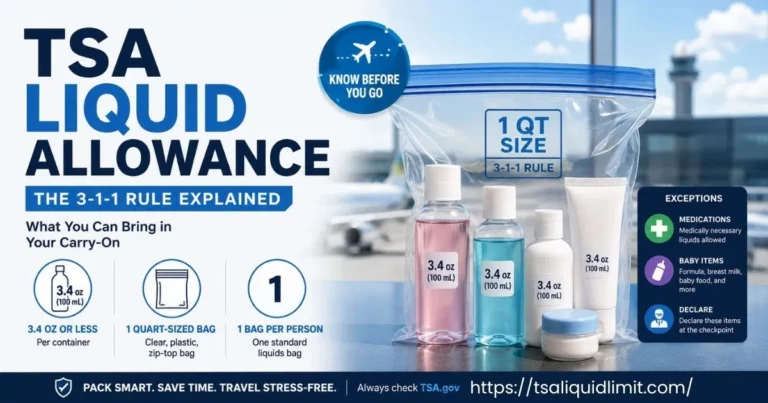
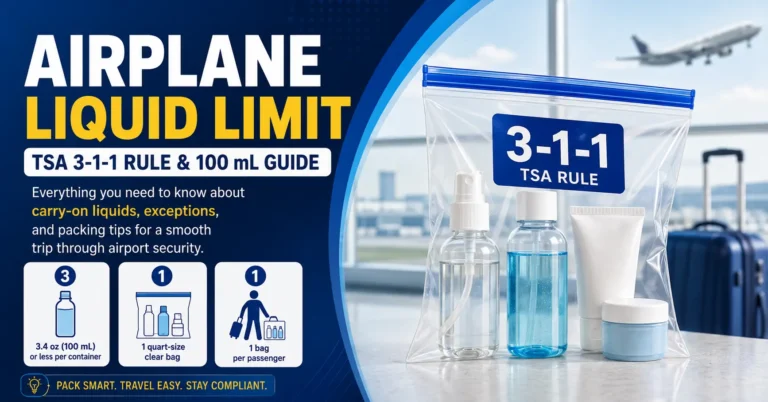
The TSA 3-1-1 liquids rule applies to liquids, gels, aerosols, creams, and pastes packed in carry-on baggage.
For standard carry-on liquids:
- Each container must hold 3.4 ounces (100 mL) or less.
- Containers should fit inside one clear, quart-size, resealable plastic bag.
- Each passenger is generally limited to one quart-size bag.
Examples include shampoo, conditioner, toothpaste, lotion, liquid cosmetics, gels, and many aerosol products.
Larger quantities may be allowed in checked baggage, depending on the item and applicable safety restrictions. TSA recommends keeping your 3-1-1 bag easily accessible because you may need to remove it during screening.
Are There Exceptions to the 3-1-1 Rule?
Yes. Some liquids, gels, and other items may qualify for exceptions, particularly when they are medically necessary or required for certain travel needs.
Because exceptions can depend on the specific item and circumstances, check TSA’s guidance for the exact product rather than assuming that every large container is permitted.
Medically Necessary Items and Medications
Medications and medically necessary liquids can receive special consideration during TSA screening.
Passengers should identify medically necessary items to the TSA officer when appropriate and be prepared for additional screening. The standard 3-1-1 restriction does not necessarily apply in the same way to medically necessary liquids, gels, and aerosols.
Examples can include:
- Prescription medications
- Insulin and other medically necessary liquids
- Medical liquids and gels
- Certain medical equipment
- Breast milk and infant feeding supplies
For the most accurate answer, search for the specific medical item in the TSA directory before traveling.
Sharp Objects and Tools
Sharp objects require particular attention when packing.
Many knives, blades, axes, and similar sharp objects are not permitted in carry-on baggage and may need to be packed in checked baggage when allowed.
If a sharp object is permitted in checked baggage, it should be securely wrapped or sheathed so that it cannot injure baggage handlers or inspectors.
Not every sharp or cutting item follows exactly the same rule, so check the individual item rather than assuming that all sharp objects are treated identically.
Batteries and Battery-Powered Devices
Battery rules depend on the type of battery, its size, and whether the battery is installed in a device or carried separately.
A key rule for travelers is that spare lithium batteries generally belong in carry-on baggage rather than checked baggage.
Electronic devices containing installed batteries may be permitted in checked baggage in certain circumstances, but they should be completely powered off and protected from accidental activation or damage. Carry-on baggage is generally preferred for many battery-powered electronics.
Examples include:
- Mobile phones
- Laptops
- Tablets
- Cameras
- Power banks
- Spare lithium batteries
- Battery-powered accessories
Always check the specific battery or device before packing because larger lithium batteries and certain specialized batteries can have additional restrictions.
Sports Equipment and Bludgeon-Type Items
Sports equipment can have different rules depending on its size, construction, and potential to be used as a striking object.
Items such as baseball bats, golf clubs, hockey sticks, and similar sporting equipment may not be permitted in carry-on baggage and may need to be transported as checked baggage.
Smaller sporting accessories may have different requirements.
If you’re traveling with sports equipment, search for the exact item in the TSA directory before packing it.
Food and Drinks
Many solid foods can generally be carried through the security checkpoint, but liquid and gel foods may be subject to the 3-1-1 rule.
Examples of items that may require additional consideration include:
- Soups
- Sauces
- Yogurt
- Peanut butter
- Jams and jellies
- Drinks
- Other spreadable or gel-like foods
An item being classified as food does not automatically mean it is exempt from liquid restrictions. Check the specific food item and quantity before traveling.
Firearms and Ammunition
Firearms have strict TSA requirements.
Firearms are not permitted in carry-on baggage. TSA states that firearms may be transported in checked baggage when they are unloaded, placed in a locked, hard-sided container, and declared to the airline.
Airline requirements and applicable laws may impose additional restrictions, so travelers should check with their airline before flying.
Flammable and Hazardous Items
Some flammable, explosive, or otherwise hazardous materials are prohibited from both carry-on and checked baggage.
For example, TSA states that fireworks are not permitted in either carry-on or checked baggage.
Other hazardous materials can have item-specific restrictions. Do not assume that an item is allowed simply because it can be safely transported under ordinary circumstances.
What Happens If You Accidentally Bring a Prohibited Item?
If TSA identifies an item that is not permitted through the security checkpoint, the available options can depend on the item, airport, and circumstances.
You may be able to:
- Return the item to your vehicle
- Place it in checked baggage if it is permitted there
- Give it to someone who is not entering the secure area
- Surrender or dispose of the item when no other option is available
Do not assume that every prohibited item will be handled in exactly the same way. If you discover a questionable item before reaching the checkpoint, ask TSA or airport personnel about your available options.
Does TSA Have the Same Rules at Every Airport?
TSA security rules are generally based on federal requirements, but screening procedures and the handling of specific situations can vary.
Airlines can also have their own baggage restrictions, including rules concerning size, weight, batteries, sporting equipment, and other items.
That means an item can be permitted by TSA but still be subject to an airline’s separate baggage policy.
For the most reliable answer, check both TSA requirements and your airline’s baggage rules before traveling.
Does TSA PreCheck Change What I Can Bring?
TSA PreCheck changes certain aspects of the screening process, but it does not mean that prohibited items suddenly become permitted.
TSA PreCheck travelers still need to follow applicable rules for liquids, prohibited items, weapons, batteries, and other restricted materials.
The main difference is that eligible PreCheck travelers may receive modified screening procedures at participating checkpoints.
Can I Put Full-Size Shampoo in My Checked Bag?
Generally, yes. The TSA 3-1-1 restriction applies to liquids carried through the security checkpoint in your carry-on baggage. Larger containers may generally be packed in checked baggage, subject to applicable restrictions.
For carry-on baggage, standard liquids must follow the 3-1-1 rule: containers of 3.4 ounces (100 mL) or less, packed in a single quart-size bag.
Can I Bring a Pocket Knife on a Plane?
A pocket knife is generally not permitted in carry-on baggage. Depending on the specific knife, it may be permitted in checked baggage.
Because knife rules can depend on the exact item, always search for the specific knife in the TSA directory before packing.
Can I Bring Food Through TSA?
Many foods are permitted, particularly solid foods. However, foods that are liquid, gel-like, creamy, or spreadable can be subject to the same carry-on liquid restrictions as other liquids and gels.
If you are unsure about a particular food, check the exact item before arriving at the airport.
Are TSA Rules the Same for Carry-On and Checked Bags?
No. An item can be permitted in one type of baggage but prohibited or restricted in the other.
For example, firearms are not allowed in carry-on baggage but can be transported in checked baggage when TSA and airline requirements are followed. Fireworks, on the other hand, are prohibited in both.
This is why checking the specific item and baggage type is important.
What If My Item Is Not Listed?
If you cannot find an item in the directory, do not assume that it is automatically allowed or prohibited.
Search TSA’s official What Can I Bring? database for the closest or exact item description, or contact TSA for clarification before traveling.
Rules can depend on an item’s composition, size, quantity, battery, or intended use.
Final TSA Packing Tip
The safest way to prepare for airport security is to check your items before you pack.
Use the searchable directory on this page to quickly compare carry-on and checked-bag requirements, then verify anything unusual or important against TSA’s official guidance. TSA also recommends reviewing the prohibited-items list for both carry-on and checked baggage before traveling.
Remember that the information in a general directory is a convenience tool, not a replacement for official TSA guidance. TSA officers make the final determination at the security checkpoint.
One Comment