Airplane Liquid Limit: TSA 3-1-1 Rule & 100 mL Guide
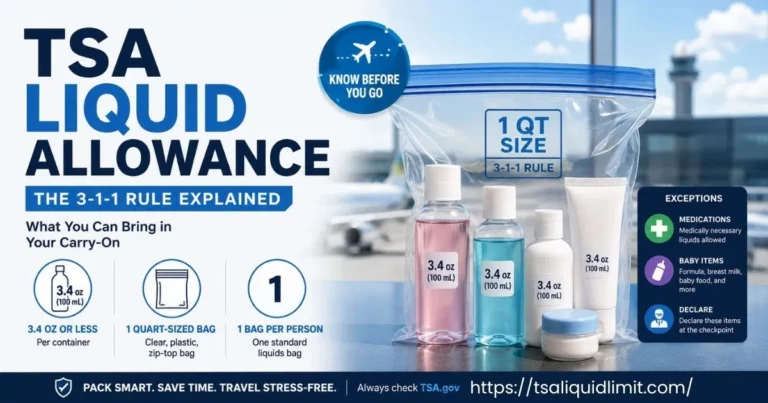
If you are flying from a U.S. airport, the standard airplane liquid limit for liquids in your carry-on is 3.4 ounces (100 mL) per container when you go through the TSA security checkpoint. The containers must fit in one quart-size, clear, plastic, zip-top bag, with one bag per passenger. This is known as the TSA 3-1-1 liquids rule.
The rule covers more than drinks. TSA applies it to liquids, aerosols, gels, creams, and pastes, which can include products such as shampoo, lotion, toothpaste, sunscreen, liquid makeup, and shaving cream.
There are exceptions for certain items, including medically necessary liquids, breast milk, infant formula, and some frozen cooling items. Separate FAA rules can also apply to toiletries, aerosols, hazardous materials, and other products.
What Is the Airplane Liquid Limit?
For standard liquids packed in a carry-on and taken through a U.S. TSA security checkpoint, the rule is:
- 3.4 ounces (100 mL) or less per container
- One quart-size clear plastic zip-top bag
- One bag per passenger
TSA’s current travel checklist continues to list these requirements.
The TSA 3-1-1 Rule at a Glance
| Rule | What it means |
|---|---|
| 3 | Each standard liquid container must hold 3.4 oz (100 mL) or less |
| 1 | Applicable liquids must fit in one quart-size clear plastic zip-top bag |
| 1 | Each passenger may bring one such bag |
The 3.4-ounce limit refers to the container size. A larger bottle does not become compliant simply because it contains less than 3.4 ounces of liquid.
For example, a 3.4-ounce bottle containing 1 ounce of shampoo fits the standard size requirement. A 6-ounce bottle containing only 1 ounce does not.
If you need to take a product in your carry-on, use a container with a capacity of 3.4 ounces or 100 mL or less.
What Is the TSA 3-1-1 Liquids Rule?
The TSA 3-1-1 rule applies to liquids, aerosols, gels, creams, and pastes carried through the security checkpoint. TSA’s current guidance describes the rule using the same three requirements: 3.4-ounce containers, one quart-size bag, and one bag per passenger.
The numbers are easy to remember:
- 3.4 ounces or 100 mL: The maximum container size for standard carry-on liquids.
- 1 quart-size bag: The applicable items must fit into one clear plastic zip-top bag.
- 1 bag per passenger: Each passenger gets one standard liquids bag.
TSA recommends keeping the 3-1-1 bag accessible in your carry-on, so it is easy to handle during screening.
Does the Container Have to Be Full?
No. What matters is the capacity of the container.
A half-empty 6-ounce bottle is still a 6-ounce container. If the product is a standard carry-on liquid, use a container with a capacity of 3.4 ounces or 100 mL or less.
What Counts as a Liquid on an Airplane?
TSA’s rule covers more than conventional liquids. It includes:
- Liquids
- Aerosols
- Gels
- Creams
- Pastes
That means products that may not look like ordinary liquids can still fall under the same security restriction. TSA’s guidance and item database include many common personal-care products and liquid or gel foods within these categories.
Common examples include:
- Shampoo
- Conditioner
- Body wash
- Lotion
- Sunscreen
- Toothpaste
- Liquid soap
- Perfume and cologne
- Liquid foundation
- Mascara
- Lip gloss
- Shaving cream
- Hair spray
- Gel deodorant
- Hand sanitizer
If you are unsure about a particular item, check the specific product in TSA’s What Can I Bring? database rather than relying on a general assumption.
What About Food?
Some foods are treated as liquids or gels for TSA screening.
Examples include:
- Hummus
- Gravy
- Creamy dips and spreads
- Creamy cheese
- Yogurt
- Sauces
- Liquid coffee
TSA’s current item database states that liquid or gel food items larger than 3.4 ounces are not allowed in carry-on bags through the checkpoint.
Solid foods can follow different rules, so check the specific food if you are uncertain.
How Much Liquid Can You Take on a Plane?
For standard carry-on liquids going through TSA screening, each container can hold up to 3.4 ounces (100 mL). The applicable containers must fit into one quart-size clear plastic zip-top bag.
There is no official TSA rule that gives every passenger a fixed number of bottles. The number you can actually pack depends on the size and shape of your containers and whether they fit inside the required quart-size bag.
Quick Reference
| Item | Standard carry-on rule |
|---|---|
| Individual liquid container | 3.4 oz / 100 mL or less |
| Liquids bag | One quart-size clear plastic zip-top bag |
| Bags per passenger | One |
| Shampoo | 3.4 oz / 100 mL or less |
| Toothpaste | 3.4 oz / 100 mL or less |
| Lotion | 3.4 oz / 100 mL or less |
| Sunscreen | 3.4 oz / 100 mL or less |
| Liquid makeup | 3.4 oz / 100 mL or less |
| Liquid medication | Exception may apply |
| Breast milk | Exception |
| Infant formula | Exception |
The exceptions are handled separately from the standard 3-1-1 bag.
How Many 3.4-Ounce Bottles Can You Bring on a Plane?
TSA does not publish a universal number of 3.4-ounce bottles that every passenger can bring.
The standard requirement is that the applicable containers fit in one quart-size bag.
The practical number depends on:
- The shape of your containers
- The size of each container
- How efficiently they fit together
- The capacity of the quart-size bag
- Whether each product actually belongs in the 3-1-1 bag
It is more accurate to think of the rule as a container-size and bag-capacity requirement, rather than a fixed bottle-count limit.
Airplane Fluid Limit vs. TSA Liquid Limit
“Airplane fluid limit” is a common way travelers describe the restriction, but TSA’s terminology is broader.
The TSA rule covers liquids, aerosols, gels, creams, and pastes.
So toothpaste, shaving cream, and some cosmetics can fall under the same screening requirements even though they are not ordinary drinks or bottled liquids.
For travelers, the useful question is whether TSA treats a particular product as subject to the 3-1-1 rule. The TSA What Can I Bring? database is the best place to check an individual item.
Liquid Limit on Airplane Carry-On Bags
The liquid limit on an airplane usually refers to what you can take through the TSA security checkpoint in your carry-on.
For standard items, remember: 3.4 ounces (100 mL) per container + one quart-size clear bag + one bag per passenger.
This is a TSA security-screening requirement. It should not be confused with the separate rules governing hazardous materials transported by air.
That distinction matters because the TSA checkpoint rule and FAA hazardous-material rules address different aspects of air travel.
Carry-On vs. Checked-Bag Liquid Rules
The 3.4-ounce TSA rule is not a universal limit for every liquid placed in checked baggage.
Carry-On Bags
Standard liquids, aerosols, gels, creams, and pastes taken through the TSA security checkpoint generally need to comply with the 3-1-1 rule.
Checked Bags
Different rules can apply to liquids in checked baggage.
The FAA regulates hazardous materials and dangerous goods transported by air. Some personal medicinal and toiletry articles are permitted under specific conditions. For qualifying medicinal and toiletry articles, the FAA states that the total aggregate quantity cannot exceed 2 L or 2 kg per person, and the capacity of each container cannot exceed 500 mL or 0.5 kg under the applicable exception.
The FAA also notes that liquids, gels, and aerosols in carry-on baggage remain subject to the TSA 100 mL checkpoint restriction.
So there are two separate questions:
- Can I take this through the TSA checkpoint in my carry-on?
- Can I transport this product in checked baggage?
The answer can be different.
TSA Liquid Limit Exceptions
Some items can exceed the standard 3.4-ounce limit at the TSA checkpoint.
Medically Necessary Liquids
TSA allows medically necessary liquids, medications, and creams in quantities greater than 3.4 ounces or 100 mL when they are needed for the trip. These items do not have to fit inside the standard quart-size bag. Travelers should tell the TSA officer at the beginning of screening that they are carrying medically necessary liquids. Additional screening may be required.
Keep these items accessible so they can be presented separately if requested.
Breast Milk
Breast milk can be carried through the TSA checkpoint in quantities greater than 3.4 ounces or 100 mL. It does not have to fit inside the quart-size bag.
Tell the TSA officer at the beginning of screening that you are carrying breast milk.
Baby Formula and Toddler Drinks
TSA allows breast milk, infant formula, toddler drinks, and baby or toddler food in quantities greater than 3.4 ounces or 100 mL. These items do not have to fit into the quart-size bag.
These items may receive additional screening. TSA’s current guidance recommends informing the officer that you are carrying them.
Ice and Gel Packs
Frozen liquid items and gel packs can pass through the checkpoint when they are frozen solid. TSA’s current item guidance states that if a frozen item is partially melted, slushy, or has liquid at the bottom of the container, it may become subject to the applicable liquid restrictions.
Separate provisions can apply to cooling packs used with medically necessary liquids, breast milk, or formula.
Can You Bring Water on a Plane?
A full bottle of water larger than 3.4 ounces generally cannot pass through the standard TSA checkpoint under the 3-1-1 rule.
An empty reusable bottle is a practical alternative. TSA permits empty drink containers through the checkpoint, so you can fill the bottle after security.
You can also purchase drinks after passing through security. Those purchases are made after the initial checkpoint screening.
Can You Bring Shampoo, Lotion, and Sunscreen?
Yes. These products can generally be carried in a carry-on when their containers comply with the TSA 3-1-1 rule.
For standard carry-on screening, use containers with a capacity of 3.4 ounces (100 mL) or less.
Some products also fall under FAA hazardous-material rules. The FAA’s medicinal and toiletry guidance includes products such as hairspray, perfume, shaving cream, inhalers, medicines, and sunscreen.
Common Toiletries and the TSA Liquid Rule
| Product | Carry-On at TSA Checkpoint | Additional consideration |
|---|---|---|
| Shampoo | 3.4 oz / 100 mL or less | 3-1-1 bag |
| Conditioner | 3.4 oz / 100 mL or less | 3-1-1 bag |
| Lotion | 3.4 oz / 100 mL or less | 3-1-1 bag |
| Sunscreen | 3.4 oz / 100 mL or less | FAA rules can also apply |
| Toothpaste | 3.4 oz / 100 mL or less | Treated as a paste |
| Liquid soap | 3.4 oz / 100 mL or less | 3-1-1 bag |
| Perfume | 3.4 oz / 100 mL or less | Special rules can apply to qualifying duty-free purchases |
| Liquid foundation | 3.4 oz / 100 mL or less | 3-1-1 bag |
| Mascara | 3.4 oz / 100 mL or less | Check the specific item if unsure |
| Shaving cream | 3.4 oz / 100 mL or less | Aerosol rules may also apply |
| Hairspray | 3.4 oz / 100 mL or less at checkpoint | FAA rules also apply |
TSA’s item database should be used for unusual products because individual items can have additional requirements.
Can You Bring Food and Drinks Through TSA?
It depends on the food. Solid foods can generally be carried in a carry-on, while liquid or gel foods can fall under the 3-1-1 rule.
For example, TSA lists hummus as a carry-on item limited to 3.4 ounces or 100 mL. Other creamy or spreadable foods can also be treated as liquids or gels for screening.
If you are unsure about a particular food, check its entry in TSA’s database before traveling.
What About Frozen Food?
Frozen items can be carried through security when they meet TSA’s applicable requirements. For ice and gel packs, TSA states that frozen items are allowed through the checkpoint when they are frozen solid. If they are partially melted or contain liquid, the applicable liquid restrictions can apply.
What Happens If Your Liquid Is Over 3.4 Ounces?
If a standard carry-on liquid is in a container larger than 3.4 ounces or 100 mL, it generally does not meet the standard TSA liquid requirement.
Depending on the item, you can:
- Put it in checked baggage if the product is permitted there.
- Transfer an appropriate product into a compliant travel-size container.
- Leave the item at home.
- Check the specific product in TSA’s “What Can I Bring?” database.
- Tell the TSA officer if the liquid qualifies for an exception.
Do not assume that a small amount of liquid in a large container meets the 3.4-ounce rule.
For hazardous materials, check the FAA’s PackSafe guidance. Some products are prohibited in both carry-on and checked baggage regardless of their container size.
Does TSA PreCheck Change the Liquid Limit?
TSA PreCheck changes parts of the screening process, but travelers should still follow the applicable TSA liquid restrictions.
TSA checkpoint guidance indicates that TSA PreCheck passengers generally do not need to remove their 3-1-1 liquids bag from their carry-on during screening.
Not having to remove the bag does not mean the standard liquid requirements no longer apply.
Are TSA Liquid Rules Changing in 2026?
Travelers may see reports about newer airport screening technology and possible changes to liquid restrictions.
However, you should follow the current TSA requirements rather than assume a future change has already taken effect.
TSA’s current travel checklist continues to state the 3.4-ounce or 100 mL container limit, one quart-size clear plastic bag, and one bag per passenger.
If TSA changes the rule, check updated TSA guidance before your trip rather than relying on an older travel article or social media post.
FAA Rules for Toiletries, Aerosols, and Other Liquids
The TSA liquid limit is only one part of the rules that can affect what you pack.
The Federal Aviation Administration (FAA) regulates hazardous materials and dangerous goods transported by air. Its PackSafe guidance explains that many dangerous goods are prohibited, while certain personal items such as toiletries and medicines can qualify for exceptions.
This matters for products such as:
- Aerosol sprays
- Perfume
- Nail polish and remover
- Rubbing alcohol
- Inhalers
- Sunscreen
- Shaving cream
- Some flammable liquids
- Oils
- Alcoholic beverages
Aerosols
Some medicinal and toiletry aerosols are allowed when they meet the applicable FAA requirements.
For qualifying medicinal and toiletry articles, the FAA states that the total aggregate quantity cannot exceed 2 L or 2 kg per person, with each container limited to 500 mL or 0.5 kg. Aerosol release devices must also be protected against accidental release.
These FAA quantity limits do not override the TSA checkpoint requirement for standard carry-on liquids and aerosols. Carry-on containers are still subject to the TSA 100 mL rule at the security checkpoint.
Flammable Aerosols
Some flammable aerosols that do not qualify as medicinal or toiletry articles are prohibited in both carry-on and checked baggage.
The FAA lists examples such as certain lubricants, spray paints, spray starch, and cooking sprays among prohibited flammable aerosols.
That is why you should check the exact product rather than assume that every aerosol is treated the same way.
Oils
The FAA has separate guidance for oils and other potentially hazardous products. A product can be permitted under FAA baggage rules while still being subject to the TSA 100 mL checkpoint restriction when carried in your carry-on.
What About Duty-Free Liquids?
Duty-free liquids can have different requirements from liquids you bring from home.
Qualifying duty-free purchases can be subject to specific aviation and security conditions. If you have a duty-free liquid and are connecting through another airport, check the requirements for your itinerary before opening or repacking the item.
For international travel, customs requirements can also affect what you may bring into your destination country.
How to Pack Liquids for Airport Security
A little preparation can make the security checkpoint easier.
Before You Leave Home
- Check the container size. Standard carry-on liquids should be in containers of 3.4 ounces or 100 mL or less.
- Separate applicable liquids. Put liquids, gels, creams, pastes, and aerosols that fall under 3-1-1 into one quart-size clear plastic zip-top bag.
- Keep the bag accessible. TSA recommends placing the 3-1-1 bag somewhere that is easy to access during screening.
- Separate medical liquids. Keep medically necessary liquids accessible and tell the TSA officer about them.
- Check unusual products. Search the TSA “What Can I Bring?” database when you are unsure.
- Check hazardous products separately. Use FAA PackSafe for aerosols, chemicals, fuels, and other products that may be classified as dangerous goods.
At the TSA Checkpoint
If you have an exception, such as medically necessary liquid medication, breast milk, or infant formula, tell the TSA officer at the beginning of screening.
These items may require additional inspection or testing.
Airplane Liquid Limit Checklist
Before heading to the airport, check the following:
- Standard carry-on liquid containers are 3.4 oz / 100 mL or less
- Applicable liquids fit in one quart-size clear plastic zip-top bag
- You have one standard liquids bag
- The bag is easy to access at security
- Medical liquids are separated and ready for screening
- Baby formula or breast milk is separated if applicable
- Frozen ice or gel packs are frozen solid when required
- Unusual foods or liquids have been checked in TSA’s database
- Hazardous or aerosol products have been checked against FAA guidance
Frequently Asked Questions
What is the liquid limit on an airplane?
For standard liquids in carry-on baggage going through a U.S. TSA security checkpoint, each container must be 3.4 ounces (100 mL) or less. The applicable liquids must fit in one quart-size clear plastic zip-top bag, with one such bag per passenger.
Is 100 mL the same as 3.4 ounces?
TSA states the standard limit as 3.4 ounces (100 mL). The two figures are used together in TSA’s 3-1-1 guidance.
Can I bring a 4-ounce bottle that is only half full?
The safer approach is no. The standard rule is based on the container size. A container with a capacity greater than 3.4 ounces does not become compliant simply because it is partly empty.
How many 3.4-ounce bottles can I bring?
TSA does not specify a universal bottle count. The applicable containers must fit inside your single quart-size liquids bag. The practical number depends on the size and shape of the containers.
Does toothpaste count as a liquid?
Toothpaste is treated as a paste under TSA’s liquids, gels, creams, and pastes restrictions. Standard carry-on toothpaste should therefore comply with the 3.4-ounce/100 mL container limit.
Can I bring shampoo in my carry-on?
Yes. Standard shampoo containers taken through the TSA checkpoint should be 3.4 ounces or 100 mL or less and fit within the applicable 3-1-1 bag.
Can I bring perfume on a plane?
Yes. Standard perfume in a carry-on should comply with the TSA 3.4-ounce/100 mL rule. Perfume can also be subject to separate FAA rules depending on how and where it is purchased and transported.
Can I bring water through TSA?
A full bottle of water larger than 3.4 ounces generally cannot pass through the standard TSA checkpoint under the 3-1-1 rule. An empty drink container can pass through security.
Can I bring liquid medication over 3.4 ounces?
Yes. Medically necessary liquid medication can exceed 3.4 ounces or 100 mL when it is needed for the trip. Tell the TSA officer at the beginning of screening so the medication can receive the appropriate additional screening.
Can I bring breast milk or baby formula over 3.4 ounces?
Yes. TSA allows breast milk, infant formula, toddler drinks, and qualifying baby or toddler food in quantities greater than 3.4 ounces or 100 mL. These items do not have to fit in the quart-size bag.
Do liquids in checked baggage have the 3.4-ounce limit?
Not as a blanket TSA rule. The 3.4-ounce restriction applies to standard liquids going through the TSA checkpoint in carry-on baggage. Checked baggage can be subject to separate FAA hazardous-material and product-specific rules.
Does TSA PreCheck remove the liquid limit?
No. TSA PreCheck can change how some items are screened, including whether you need to remove the 3-1-1 bag, but travelers should continue following the applicable TSA liquid requirements.
What should I do if I am unsure about a liquid?
Search for the specific product in TSA’s What Can I Bring? database. For products that may be hazardous, also check FAA PackSafe. TSA’s item-specific guidance is more reliable than assuming every liquid follows exactly the same rule.
Conclusion
For most travelers departing from a U.S. airport, the standard airplane liquid limit is:
3.4 ounces (100 mL) or less per container, one quart-size clear plastic bag, and one bag per passenger.
That rule applies to standard liquids, gels, aerosols, creams, and pastes in carry-on baggage at the TSA checkpoint.
However, it is not a universal 3.4-ounce limit for every liquid in every type of baggage. Medically necessary liquids, breast milk, infant formula, certain cooling items, and some other products can have different screening requirements. FAA hazardous-material rules can also apply to aerosols, chemicals, alcohol, oils, and other products.
When you are unsure about a particular product, check TSA’s What Can I Bring? database and, when applicable, FAA PackSafe before traveling. That is the most reliable way to determine whether an item can go in your carry-on, checked baggage, or neither.