TSA 3-1-1 Rule: Everything You Need to Know (2026)
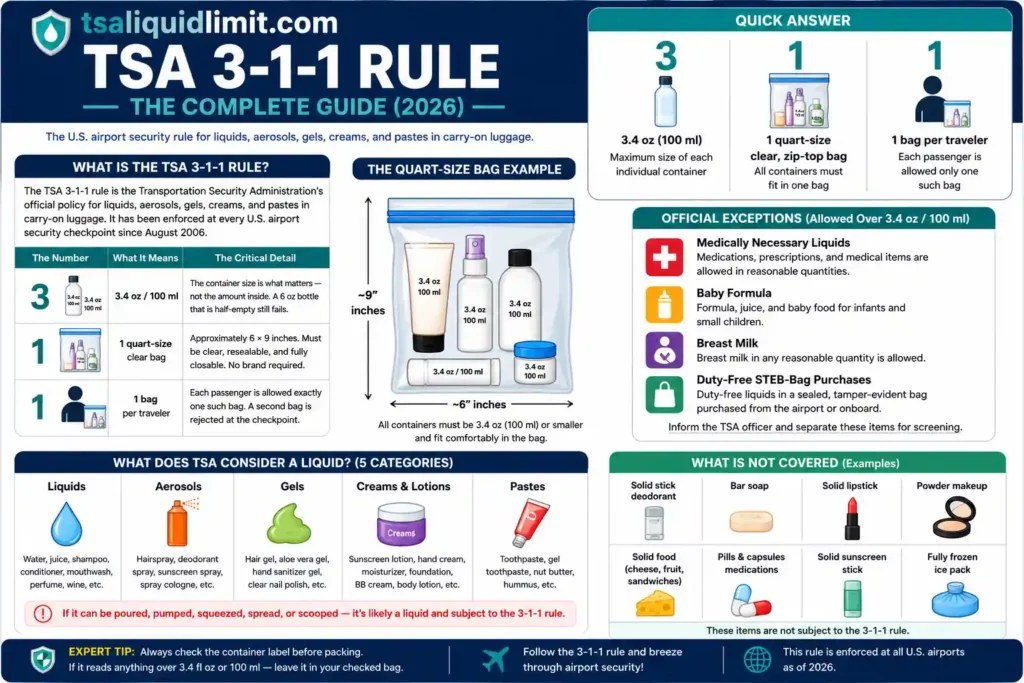
The TSA 3-1-1 rule is the U.S. airport security policy for carry-on liquids. It has three parts:
3 → Each container must be 3.4 oz (100 ml) or smaller
1 → All containers must fit inside 1 clear, quart-size, zip-top bag
1 → Each traveler may carry only 1 such bag
It applies to all liquids, aerosols, gels, creams, and pastes on every flight departing a U.S. airport.
Official exceptions: medically necessary liquids, baby formula, breast milk, and duty-free STEB-bag purchases are allowed over the limit. (See more > TSA Liquid Exceptions)
What Is the TSA 3-1-1 Rule?
The TSA 3-1-1 rule is the Transportation Security Administration’s official policy for liquids, aerosols, gels, creams, and pastes in carry-on luggage. It has been enforced at every U.S. airport security checkpoint since August 2006 – on domestic flights, international departures, and connecting flights through U.S. airports alike. The three digits in its name each represent one specific, non-negotiable requirement.
| The Number | What It Means | The Critical Detail | |
| 3 | 3.4 oz / 100 ml | Maximum size of each individual liquid container | The container size is what matters – not the amount inside. A 6-oz bottle that is half-empty still fails. The bottle itself must not exceed 3.4 oz. |
| 1 | 1 quart-size clear bag | All containers must fit in one transparent, zip-top bag | Approximately 6 × 9 inches. Must be clear, resealable, and fully closable. No brand required – Ziploc or any quart-size clear bag works. |
| 1 | 1 bag per traveler | Each passenger is allowed exactly one such bag | Adults and children each count as one traveler. A second bag is rejected at the checkpoint. No exceptions for families traveling together. |
⚡ Expert Tip: The Container Rule — The Most Common Mistake
TSA enforces the 3-1-1 rule based on container size, not the volume of liquid inside.
✅ A 3 oz / 88 ml bottle filled to the brim: PASSES
❌ A 4 oz / 118 ml bottle with only 1 oz inside: FAILS — the bottle is oversized
❌ A 6 oz / 177 ml travel shampoo that is half-used: FAILS — the container itself is over the limit
Always check the container label before packing. If it reads anything over 3.4 fl oz or 100 ml, leave it in your checked bag.
Who Must Follow the 3-1-1 Rule?
Every passenger on every flight departing a U.S. airport must follow the 3-1-1 rule — regardless of nationality, ticket class, frequent flyer status, airline, or destination. This includes:
- U.S. citizens and foreign nationals
- First class, business class, and economy passengers are equally
- Adults and children (infants have a separate formula/breast milk exception > TSA Liquid Exception )
- TSA PreCheck members — PreCheck does NOT waive the liquid limit
- Travelers on domestic AND international flights from U.S. airports
Why Does the 3-1-1 Rule Exist? The History Behind It
The 3-1-1 rule did not arise from routine policy evolution — it was born from a real, nearly successful terrorist attack. On August 10, 2006, British authorities arrested 24 individuals who had plotted to smuggle liquid explosives — disguised as beverages and personal care products — onto at least 10 transatlantic flights bound for the United States and Canada. The plan, known as the 2006 transatlantic aircraft plot, was designed to detonate the bombs mid-flight, potentially killing thousands.
The critical problem the plot revealed: conventional airport X-ray machines could not reliably detect liquid explosive precursors. A bottle of hydrogen peroxide, a sports drink laced with an oxidizer, a hair gel tube filled with explosive paste — all could pass through standard screening undetected. Within days of the arrests, the TSA and the UK’s Department for Transport simultaneously announced the 100 ml liquid restriction. The International Civil Aviation Organization (ICAO) subsequently codified it as the global aviation security standard.
The rule has been in continuous effect for nearly 20 years. It remains the enforced standard at all U.S. checkpoints as of 2025.
Why Is It Called the ‘3-1-1 Rule’ — And Not ‘100ml Rule’?
The U.S. standard is technically 100 ml (the ICAO metric measure), but TSA branded it ‘3-1-1’ for American audiences:
→ ‘3’ represents 3.4 fl oz (the U.S. customary equivalent of 100 ml, rounded up slightly)
→ The first ‘1’ represents one quart-size bag
→ The second ‘1’ represents one bag per traveler
The ‘3-1-1’ mnemonic was created by TSA’s communications team in 2006 for ease of recall.
Important: The UK, EU, Canada, and Australia all use the same 100 ml limit but call it the ‘100ml rule,’ not ‘3-1-1.’ The ‘3-1-1’ name is uniquely American.
What Does TSA Consider a Liquid? Every Category Explained
The 3-1-1 rule covers five substance categories. Most travelers correctly identify liquids — but many are surprised by what TSA classifies as a gel, cream, or paste. Understanding each category prevents confiscation at the checkpoint.
| Category | TSA Definition | Examples | Surprising Inclusions |
| Liquids | Any substance that flows freely at room temperature | Water, juice, shampoo, conditioner, mouthwash, cologne, perfume, wine, spirits | Coffee in a travel mug from home; smoothies and protein shakes; liquid vitamins; eye drops |
| Aerosols | Pressurized spray canister — any substance dispensed by propellant gas | Hairspray, spray deodorant, spray sunscreen, dry shampoo spray, spray cologne, insect repellent spray | Dry shampoo (aerosol type only); cooking spray; spray paint (also hazmat — prohibited entirely) |
| Gels | Semi-solid, jelly-like consistency that holds shape but deforms under pressure | Hair gel, aloe vera gel, contact lens solution, hand sanitizer gel, clear lip gloss | Mascara (classified as gel); clear nail polish; hair wax and pomade; gel shoe insoles |
| Creams & Lotions | Thick emulsion between liquid and solid — pourable but not freely flowing | Sunscreen lotion, hand cream, moisturizer, face cream, BB cream, tinted moisturizer, foundation | Diaper cream; all liquid/cream makeup; body butter; massage oil; primer |
| Pastes | Thick spreadable consistency — not pourable but spreadable | Toothpaste, gel toothpaste, whitening paste | Peanut butter; hummus; Nutella; soft cheese; brie; guacamole; nut butters; spreadable dips |
What Is NOT Covered — Solids, Powders, and Exempt Items
These items are not classified as liquids and are not subject to the 3-1-1 rule:
| Item | Rule Applies? | Notes |
| Solid stick deodorant | ❌ Not a liquid | Any size. No quart bag needed. |
| Bar soap | ❌ Not a liquid | Any size. No bag restriction. |
| Solid lipstick | ❌ Not a liquid | Solid form only. Lip gloss = liquid rule applies. |
| Powder makeup (pressed or loose) | ❌ Not a liquid (under 12 oz) | Powder over 12 oz may need separate bin at checkpoint. |
| Solid food — cheese, fruit, sandwiches | ❌ Not a liquid | Solid foods exempt. Spreadable foods (peanut butter, hummus) = liquid rule. |
| Pills and capsule medications | ❌ Not a liquid | Tablets, capsules, gummies, vitamins: fully exempt. |
| Solid perfume | ❌ Not a liquid | Wax-based solid perfume sticks are not liquids. |
| Chapstick / solid lip balm | ❌ Not a liquid | Solid stick form is exempt. |
| Solid sunscreen stick | ❌ Not a liquid | Wax-based stick form is exempt — a useful solid alternative. |
| Fully frozen ice pack | ❌ Not a liquid (if fully solid) | Partially melted = treated as liquid. Keep it frozen. |
| ⚡ Expert Tip: The Spreadable Food Test — Know Before You Pack |
| TSA applies a simple mental test to food items: if it can be spread, smeared, or poured, it counts as a liquid. |
| ✅ Hard cheddar cheese block → Solid. Not subject to rule. |
| ❌ Brie or soft cheese → Spreadable. Subject to 3.4 oz limit. |
| ✅ Whole apple → Solid. Not subject to rule. |
| ❌ Applesauce → Pourable. Subject to 3.4 oz limit. |
| ❌ Peanut butter → Spreadable. Subject to 3.4 oz limit. Full jars go in checked bag. |
| ❌ Hummus → Spreadable. Subject to 3.4 oz limit. |
| When in doubt at the packing stage: if it has the consistency of something you’d spread on toast, put it in checked luggage or limit to 3.4 oz in your carry-on. |
What Is a Quart-Size Bag — and What Exactly Qualifies?
The quart-size bag is the second requirement of the 3-1-1 rule and the source of the most frequent checkpoint confusion. TSA does not mandate a specific brand, exact dimensions, or a specially labeled product. The three non-negotiable requirements are: clear, resealable, and approximately quart-size.
| Requirement | Full Specification |
| Approximate dimensions | ~6 × 9 inches or 1 quart volume (~946 ml). TSA does not enforce exact dimensions. A bag that is clearly quart-size — not pint-size, not gallon-size — is accepted. |
| Transparency | 100% clear. TSA officers must be able to see all contents through the bag without opening it. Frosted, tinted, colored, or opaque bags fail this requirement. |
| Closure type | Resealable only — zip-top, slider-top, or press-seal. Tied bags, rubber-banded bags, or folded-over tops do not comply. The seal must close completely. |
| Brand | No brand requirement. Ziploc, Hefty, store brands, purpose-made TSA travel bags — all accepted. Look for ‘quart size’ on any packaging. |
| Quantity per traveler | Exactly one bag per person. This includes children and infants (each has their own allowance). A second bag will be rejected. |
| Checkpoint placement | Standard lane: remove from carry-on, place in a separate screening bin. PreCheck lane: may leave in carry-on. |
| Fill level | The bag must close completely. If the zip cannot seal flat, it is over-filled. Remove one item. |
| Reusability | The same bag may be reused indefinitely. Replace when the seal becomes weak or the bag tears. |
How Many Items Fit in a Quart-Size Bag?
Typically 6 to 10 travel-size items, depending on container shape. Flat silicone squeeze bottles pack significantly more efficiently than round rigid bottles. Here is a realistic weekend-trip quart bag:
| Item | Size |
| Shampoo | 3.4 oz / 100 ml |
| Conditioner | 3.4 oz / 100 ml |
| Toothpaste | 3 oz / 88 ml |
| Face wash | 3.4 oz / 100 ml |
| Moisturizer / sunscreen | 3.4 oz / 100 ml |
| Mouthwash | 1 oz / 30 ml |
| Perfume or cologne | 0.5 oz / 15 ml |
| Total — 7 items | ~18 oz combined |
| ⚡ Expert Tip: Can You Bring More Than One Quart-Size Bag? |
| No. TSA allows exactly one quart-size bag per traveler — no exceptions for this rule. |
| Two strategies if you regularly run out of space: |
| 1. Switch to solid alternatives: solid shampoo bars, solid deodorant, solid sunscreen stick, solid perfume — none are subject to the 3-1-1 rule. |
| 2. Use the smallest possible containers — 1 oz and 2 oz travel bottles instead of 3.4 oz — to fit more items in the same space. |
| Note: medically necessary liquids, baby formula, and breast milk are carried separately and do NOT count toward your one quart bag. |
Why 3.4 oz? Understanding the 100 ml Measurement
The TSA liquid limit is officially 100 milliliters (ml) — the metric measure adopted from the ICAO international aviation security standard. In the United States, 100 ml equals exactly 3.38 fl oz, which the TSA rounds to 3.4 oz for communication purposes. The two measurements are identical in practice.
| Measurement | Value | Equivalent | TSA Status |
| TSA liquid limit | 3.4 fl oz | 100 ml | ✅ Per individual container |
| 100 ml (exact) | 3.38 fl oz | 100 ml | ✅ Rounds to 3.4 oz |
| 3 oz bottle | 3 fl oz | 88.7 ml | ✅ Under limit — compliant |
| 3.4 oz bottle | 3.4 fl oz | 100.6 ml | ✅ Compliant |
| 4 oz bottle | 4 fl oz | 118.3 ml | ❌ Over limit — fails |
| 5 oz bottle | 5 fl oz | 147.9 ml | ❌ Over limit — fails |
| Airline mini spirit bottle | 1.69 fl oz | 50 ml | ✅ Compliant — well under |
| Perfume travel vial | 0.17 fl oz | 5 ml | ✅ Compliant |
| Quart bag total capacity | ~32 fl oz | ~946 ml | Combined max (if seal closes) |
| ⚡ Expert Tip: Shopping for Travel-Size Bottles in the U.S. |
| U.S. pharmacy shelves mostly use fl oz labeling — look for ‘3 oz’ or ‘3 fl oz’ or ‘3.4 oz.’ |
| Imported products more commonly show ‘100 ml.’ Both measurements are equally compliant. |
| Refillable silicone squeeze bottles (sets of 5 for ~$10–$20): far more economical than buying new travel-size products before every trip. |
| Flat silicone bottles pack more items into the quart bag than round rigid containers. |
| For fragrance: a 5 ml or 10 ml glass atomizer holds 1–2 weeks’ worth of perfume or cologne in a fraction of the space. |
Can You Bring [Item] on a Plane? — Complete 3-1-1 Reference Table
This table covers every common item travelers ask about. Each row states the rule clearly, and items with dedicated full guides are linked for deeper detail.
| Item | Carry-On? | Limit | Notes |
| Shampoo & conditioner | ✅ Yes | 3.4 oz | Full-size only in checked bag. |
| Toothpaste (all types) | ✅ Yes | 3.4 oz | Gel, whitening, paste — all subject. |
| Deodorant — spray/gel | ✅ Yes | 3.4 oz | Solid stick: NOT a liquid — no bag needed. |
| Cologne / perfume | ✅ Yes | 3.4 oz | Full-size in checked bag only. |
| Spray sunscreen | ✅ Yes | 3.4 oz | Aerosol. Up to 18 oz per can in checked bag. |
| Lotion / moisturizer | ✅ Yes | 3.4 oz | Cream, serum, body lotion — all subject. |
| Hairspray | ✅ Yes | 3.4 oz | Aerosol. Up to 18 oz/can in checked bag. |
| Dry shampoo (aerosol) | ✅ Yes | 3.4 oz | Powder dry shampoo generally exempt under 12 oz. |
| Hand sanitizer | ✅ Yes | 3.4 oz | COVID 12 oz exception expired. Back to 3.4 oz. |
| Liquid / cream makeup | ✅ Yes | 3.4 oz | Foundation, BB cream, concealer, tinted moisturizer. |
| Mascara | ✅ Yes | 3.4 oz | Classified as a gel. Most tubes are under 3.4 oz. |
| Mouthwash | ✅ Yes | 3.4 oz | Travel-size widely available (1 oz). |
| Contact lens solution | ✅ Yes | 3.4 oz | Prescription/medically necessary sizes: declare at checkpoint. |
| Baby formula | ✅ Exempt | No limit | Does not count toward quart bag. Declare at checkpoint. |
| Breast milk | ✅ Exempt | No limit | Infant does not need to be present. Cannot be made to taste. |
| Liquid medication (Rx) | ✅ Exempt | Travel amount | Declare at checkpoint. Label recommended. |
| Liquid OTC medication | ✅ Exempt | Travel amount | Declare at checkpoint. Keep in original packaging. |
| Duty-free liquids (STEB) | ✅ Exempt | No limit | Must be sealed in a tamper-evident STEB bag with receipt. |
| Water (from home) | ❌ No | 0 oz | Bring an empty bottle, fill post-security. |
| Peanut butter / hummus | ⚠️ Limited | 3.4 oz | Spreads count as paste/liquid. Full jars → checked bag. |
Official Exceptions to the TSA 3-1-1 Rule
Four categories of liquid are officially exempt from the 3-1-1 rule. They may exceed 3.4 oz in carry-on bags and do not need to fit in the quart-size bag.
- Medically necessary liquids — prescriptions, insulin, OTC liquid medications, liquid nutritional supplements
- Baby formula — any amount; infant need not be present
- Breast milk and toddler drinks — any amount; cannot be made to open or taste
- Duty-free liquids — purchased post-security in a sealed STEB tamper-evident bag with visible receipt
All excepted items must be verbally declared to the TSA officer before screening.
| Exception | Quantity | Key Conditions |
| Prescription liquid medication | Travel amount | Declare at checkpoint. Pharmacy label recommended. No doctor’s note legally required. |
| OTC liquid medication | Travel amount | Declare at checkpoint. Keep in original packaging. |
| Insulin and injectables | Any amount | Declare with syringes, pens, and lancets. Related diabetes supplies are also permitted. |
| Prescription eye drops | Any amount | Declare at checkpoint. |
| Liquid nutritional supplements (medical) | Reasonable amount | Declare; carry documentation if possible. |
| Baby formula — liquid | Reasonable travel amount | Declare at checkpoint. No infant required to be present. |
| Breast milk | Reasonable travel amount | Declare. Cannot be made to open, taste, or transfer. |
| Toddler drinks and juice | Reasonable amount | For young children only. Adult beverages are NOT exempt. |
| Duty-free liquids (intact STEB bag) | No limit | STEB seal must be unbroken. Receipt must be visible. International connections: check local rules. |
Does TSA PreCheck Change the 3-1-1 Rule?
TSA PreCheck does NOT waive the 3-1-1 liquid rule.
The 3.4 oz per container limit and one-quart-bag maximum both still apply in PreCheck lanes.
What PreCheck changes: you do NOT need to remove your quart-size bag from your carry-on during X-ray screening.
All liquid exceptions (medications, baby formula, breast milk) apply equally in PreCheck lanes.
| Checkpoint Rule | Standard Lane | TSA PreCheck Lane |
| 3.4 oz per container limit | ✅ Yes — enforced | ✅ Yes – still enforced |
| One quart bag per traveler | ✅ Yes | ✅ Yes |
| Quart bag must be removed from carry-on | ✅ Yes — mandatory | ❌ No – stays in bag |
| Laptop must be removed | ✅ Yes | ❌ No |
| Shoes must be removed | ✅ Yes | ❌ No |
| Belt must be removed | ✅ Yes | ❌ No |
| Liquid medications: declare at checkpoint | ✅ Yes | ✅ Yes — same rule applies |
| Baby formula / breast milk exception | ✅ Yes | ✅ Yes — same rule applies |
| Duty-free STEB bag exception | ✅ Yes | ✅ Yes — same rule applies |
3-1-1 Rule and Checked Baggage – What Changes?
The TSA 3-1-1 rule does NOT apply to checked baggage.
In checked bags: full-size shampoo, conditioner, lotions, and most personal care liquids are permitted without size restriction.
Aerosols in checked bags: permitted up to 18 oz (500 ml) per container and 70 oz (2 kg) total.
Prohibited in checked bags regardless of size: flammable aerosols (spray paint, flammable spray starch), explosive materials, and lithium batteries (which must stay in carry-on).
| Item | Checked Bag Limit | Notes |
| Shampoo, conditioner, body wash | No size limit | Full-size bottles freely permitted. |
| Lotion, moisturizer, sunscreen | No size limit | No 3.4 oz restriction. |
| Aerosol hairspray, deodorant | 18 oz per can / 70 oz total | Combined aerosol total per bag. |
| Aerosol sunscreen | 18 oz per can / 70 oz total | Same aerosol rule. |
| Mouthwash, cologne, perfume | No size limit (non-flammable) | Check if product is flammable — some are prohibited. |
| Alcohol (>70% ABV) | Prohibited | High-proof spirits cannot be checked. |
| Alcohol (24–70% ABV) | Up to 5 liters per person | In retail packaging. |
| Flammable aerosols (spray paint, etc.) | Prohibited | Hazardous material — not allowed checked or carry-on. |
Step-by-Step: Getting Through TSA Security with Your Liquids
These steps apply in both standard and PreCheck lanes. Following this exact sequence prevents your bag from being flagged for secondary inspection.
- Pack your quart bag at home – not at the checkpoint. Place all compliant liquids into your quart bag the night before your flight. Close the seal completely. Verify it closes flat. Pre-packing is the single most effective step to eliminate checkpoint delays.
- Position it for fast removal. Place the sealed quart bag in the outermost pocket or top compartment of your carry-on. You will need to pull it out in seconds when you reach the X-ray conveyor.
- Prepare excepted liquids separately. If you are carrying liquid medications, baby formula, or breast milk over 3.4 oz, move them to an accessible outer pocket before joining the security queue – not buried inside your main bag.
- Verbally declare excepted liquids. Tell the TSA officer before placing any items on the belt: ‘I have liquid medications/baby formula/breast milk to declare.’ Do this proactively — it avoids secondary inspection.
- Standard lane: place a quart bag in its own bin. Remove your quart bag from your carry-on and place it flat in a dedicated screening bin — not mixed with shoes, electronics, or your bag. PreCheck lane: leave it in your bag.
- Wait — then re-pack before moving. After your items clear the scanner, re-pack your quart bag into your carry-on before stepping away from the belt. Items left on the conveyor are one of the leading causes of lost belongings at airport checkpoints.
| ⚡ Expert Tip: The One Habit That Prevents 95% of Liquid-Related Delays |
| The most common checkpoint holdup: travelers reach the belt and discover a container over 3.4 oz, or their quart bag won’t close because it is over-filled. |
| The fix: the evening before your flight, pack your quart bag fully, attempt to close it, and hold it up. If the seal won’t close flat — remove one item. |
| Then place the fully sealed quart bag in the very top pocket of your carry-on and don’t touch it again until the checkpoint conveyor. |
| This single habit eliminates virtually all liquid-related delays and secondary inspections. |
Does the 3-1-1 Rule Apply on International Flights?
The TSA 3-1-1 rule applies to all flights departing U.S. airports — domestic and international alike. If your itinerary includes a connecting security checkpoint in another country, that country’s rules apply at the connecting checkpoint.
The good news for most international travelers: the 100 ml per container limit is the ICAO global standard, adopted by nearly every country. The primary difference is the bag: most countries use a 1-litre transparent bag (slightly larger than the U.S. quart). A correctly packed U.S. quart bag will pass at virtually all international checkpoints.
| Country / Authority | Liquid Limit | Bag Size | Key Difference from TSA |
| United States (TSA) | 100 ml / 3.4 oz | ~946 ml quart | The 3-1-1 rule. One quart bag per traveler. |
| United Kingdom (DfT) | 100 ml | 1 litre bag | Called ‘100ml rule,’ not 3-1-1. 1L bag is slightly larger. |
| European Union (ECAC) | 100 ml | 1 litre bag | Same ICAO standard. One 1L bag per passenger. |
| Canada (CATSA) | 100 ml | 1 litre bag | Virtually identical to TSA. Same exceptions. |
| Australia (ASIO/ATSA) | 100 ml | 1 litre bag | Same ICAO standard. STEB rules for duty-free. |
| India (BCAS) | 100 ml | 1 litre bag | International standard applies. Domestic may differ. |
| UAE — Dubai (GCAA) | 100 ml | 1 litre bag | Strict enforcement. Verify duty-free STEB rules. |
| Japan (MLIT) | 100 ml | 1 litre bag | Same ICAO standard. Strict enforcement. |
| ⚠️ Watch Out: Connecting Flights and Duty-Free Liquids |
| If you buy duty-free liquids at a U.S. airport and then connect through another country (UK, EU, UAE), the connecting checkpoint may apply its own STEB bag rules. |
| UK and EU checkpoints have periodically restricted acceptance of STEB bags from non-EU/non-UK airports. |
| Always check the rules of your specific connecting country before purchasing large duty-free items. |
| When in doubt: check the item in your luggage or ship it to your destination. |
New TSA Liquid Rules 2026 — Any Changes?
✅ Status: TSA 3-1-1 Rule Is Unchanged for 2026
As of June 2026, the core TSA 3-1-1 rule is fully in effect with no changes:
- The 3.4 oz (100 ml) per container limit: UNCHANGED
- The one-quart-size bag per traveler requirement: UNCHANGED
- The exceptions for medications, baby formula, breast milk, and STEB duty-free: UNCHANGED
- COVID-era hand sanitizer exception (12 oz): EXPIRED — back to standard 3.4 oz
This page is updated whenever TSA policy changes. Bookmark it for your next trip.
What the TSA Is Exploring (Not Yet Implemented)
The TSA has been deploying Computed Tomography (CT) scanning technology at select checkpoints. CT scanners create 3D X-ray images that can detect liquid explosive precursors at larger volumes than traditional 2D scanners. If CT scanning becomes universal, it could eventually allow the 3-1-1 rule to be relaxed. As of 2026, CT scanners are present at some airports, but have not resulted in any change to the 3-1-1 rule enforcement.
⚠️ Watch Out: Don’t Trust Social Media for TSA Rule Updates
Viral posts regularly circulate false claims about TSA rule changes: ‘TSA is no longer enforcing the liquid rule,’ ‘Full-size bottles are now allowed,’ ‘PreCheck members are exempt.’
None of these are true. The 3-1-1 rule is actively enforced at 100% of U.S. airport checkpoints.
Always verify rule status at TSA.gov or on this page before your flight.
Frequently Asked Questions
Conclusion
The TSA 3-1-1 rule has not changed since 2006 — and it is not changing in 2026. Three numbers are all it takes to clear security without delays: every liquid in a container of 3.4 oz (100 ml) or less, all containers in one clear quart-size zip-top bag, and one bag per traveler. That’s it.
The rule applies at every U.S. checkpoint, on every flight, for every passenger — economy or first class, domestic or international, PreCheck or standard lane. No status exempts you from the limit itself.
The four exceptions — medications, baby formula, breast milk, and sealed duty-free STEB purchases — travel outside the quart bag. Declare them before they hit the belt.
The single habit that prevents 95% of checkpoint delays: pack your quart bag the night before. Seal it, hold it up, confirm it closes flat — then drop it in your outer pocket and don’t touch it again until the conveyor.
If a container reads over 3.4 fl oz or 100 ml on the label, it does not matter how full it is. It goes in your checked bag.
Ready to pack smarter? Explore the complete guide library below — every TSA liquid rule, answered in full.
All TSA Liquid Rules
Every article below covers one specific aspect of the TSA liquid rule in full expert detail:
| Article | What It Covers |
| TSA Liquid Limit | Full 3-1-1 overview, items table, exceptions, FAQ |
| TSA Liquid Exceptions: Medications & More | All exceptions with step-by-step declaration guide |