TSA Liquid Exceptions: Medications, Baby Formula, Breast Milk & More
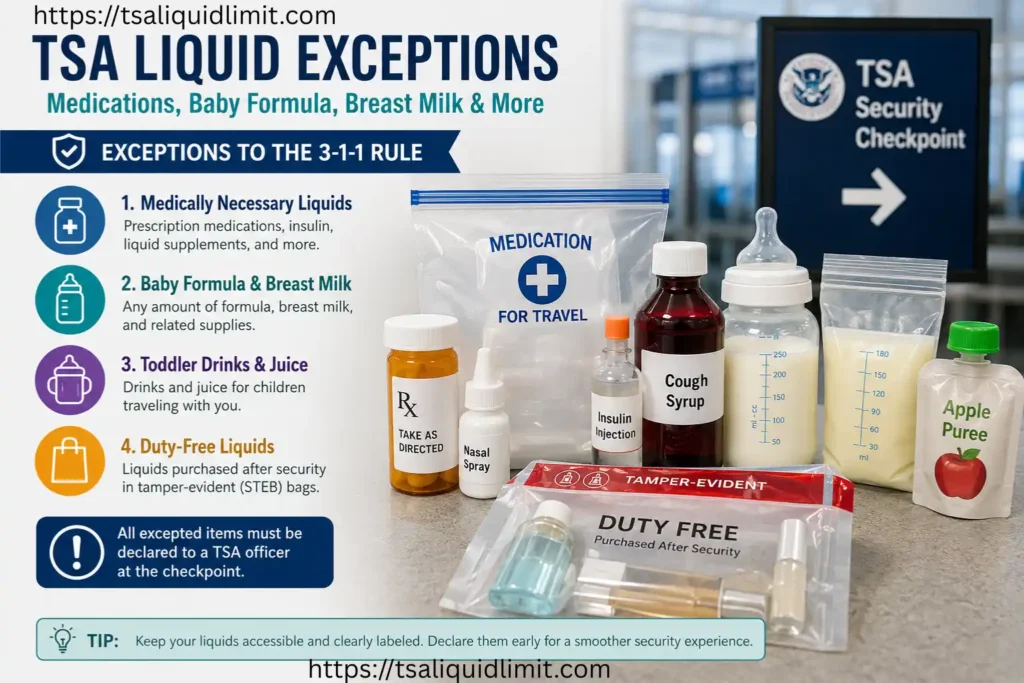
The TSA 3-1-1 rule has four official exceptions. The following items are allowed in carry-on bags in quantities exceeding 3.4 oz (100 ml) and do not need to fit inside your quart-size bag:
1. Medically necessary liquids – prescription medications, insulin, liquid supplements, eye drops
2. Baby formula and breast milk – any amount; no infant present required
3. Toddler drinks and juice – for children traveling with you
4. Duty-free liquids – purchased past the security checkpoint in tamper-evident (STEB) bags
All excepted items must be declared to a TSA officer at the checkpoint before screening
Why Does the TSA 3-1-1 Rule Have Exceptions?
The TSA 3-1-1 rule — which limits carry-on liquids, aerosols, gels, creams, and pastes to 3.4 oz (100 ml) per container in a single quart-size bag — was designed to prevent liquid explosive precursors from reaching aircraft cabins. However, the Transportation Security Administration recognizes that certain liquids are medically essential, nutritionally necessary for infants, or acquired in controlled post-security environments where the security risk is already mitigated.
These exceptions are not loopholes. They are formally written into TSA policy and apply equally at every U.S. airport checkpoint, regardless of the airline, destination, or ticket class. Understanding exactly which items qualify — and how to present them correctly — is the difference between a smooth checkpoint experience and a stressful one.
| ⚡ Before You Pack: Know the Difference Between Exceptions and Exemptions |
| • Exceptions = TSA actively permits the item in quantities over 3.4 oz in carry-on bags. |
| • Exemptions = The item is not classified as a liquid at all (e.g., solid deodorant, bar soap, powder). |
| • This article covers exceptions only — items that would normally violate the 3-1-1 rule but are explicitly permitted. |
Exception 1: Liquid Medications and Medically Necessary Liquids
| You can bring liquid prescription medication on a plane in any quantity needed for your trip. Liquid medications are exempt from the 3.4 oz limit and do not need to fit in your quart-size bag. You must declare them to the TSA officer at the checkpoint. |
The TSA explicitly permits passengers to carry liquid medications in quantities greater than 3.4 oz (100 ml) in their carry-on bags. This exemption applies regardless of whether you have a TSA PreCheck membership, and it applies at every U.S. airport security checkpoint.
What Qualifies as a Medically Necessary Liquid?
The TSA broadly defines medically necessary liquids. The following categories are all covered:
| Category | Examples | Status |
| Prescription medications | Liquid antibiotics, liquid pain relievers, cough syrup (prescribed) | ✅ Permitted — any quantity |
| Injectable medications | Insulin, blood thinners, allergy epinephrine (EpiPen liquid) | ✅ Permitted — declare with needles |
| OTC liquid medications | Children’s liquid Tylenol, liquid antacids, liquid antihistamines | ✅ Permitted — declare at checkpoint |
| Prescription eye drops | Antibiotic eye drops, glaucoma drops, steroid eye drops | ✅ Permitted — any quantity |
| Liquid nutritional supplements | Liquid vitamins, medical nutritional drinks (e.g., Ensure), tube feeding supplies | ✅ Permitted — reasonable quantity |
| Dialysis and medical equipment fluids | Saline, dialysate solutions, CPAP distilled water | ✅ Permitted — declare separately |
| Topical prescription liquids | Prescription liquid antiseptics, wound irrigation solutions | ✅ Permitted — must be labeled |
| Homeopathic/herbal liquid remedies | Herbal tinctures, flower remedies | ✅ Permitted — though may face additional screening |
Do You Need a Doctor’s Note or Prescription Label?
TSA does not legally require a prescription label or a doctor’s note to carry liquid medication through a checkpoint. However, having your medication in its original pharmacy-labeled container significantly reduces the chance of additional screening or questions from a TSA officer. If your medication is in an unlabeled container, you may be asked to explain its purpose — bring documentation if possible.
Can You Bring OTC (Over-the-Counter) Liquid Medication?
Yes. Over-the-counter liquid medications — including children’s liquid pain relievers, liquid cough medicine, liquid antacids, and similar products — are also exempt from the 3.4 oz rule. TSA does not distinguish between prescription and OTC liquid medication for the purposes of the quantity exemption. Declare any OTC liquid medication that exceeds 3.4 oz at the checkpoint.
What About Insulin and Syringes?
Insulin is one of the most commonly carried medically necessary liquids. TSA permits passengers with diabetes to carry insulin, insulin pens, syringes, lancets, glucose meters, and related supplies through the checkpoint without quantity restrictions. Insulin does not need to be refrigerated for short-term travel. Syringes must be accompanied by the insulin vials or similar medication — unused syringes alone may draw additional questions.
| ⚡ Expert Tip: How to Declare Medication at the TSA Checkpoint |
| • Remove all liquid medications from your bag before placing it on the X-ray conveyor. |
| • Tell the TSA officer verbally as you approach: ‘I have liquid medications to declare.’ |
| • Place medications in a separate bin — not inside your carry-on — for independent screening. |
| • Keep original pharmacy labels on prescription medications wherever possible. |
| • If your medication requires refrigeration, ice packs and gel packs are also permitted in medically necessary quantities — even if they are partially frozen or slushy. |
| • Declaring proactively is always faster than having your bag pulled for secondary inspection. |
What If TSA Wants to Screen My Medication?
TSA officers may request additional screening of liquid medications, which can include X-ray imaging, chemical testing strips, or visual inspection. You can request that your medication not be X-rayed — TSA policy allows this, and officers will use an alternative screening method. This may add a few minutes to your checkpoint time. You are never required to open a sealed medication container for tasting.
| ⚠️ Common Mistake: Don’t Assume OTC Liquid Medicine Is Automatically Waved Through |
| Many travelers assume that if something is purchased off a pharmacy shelf, it doesn’t need to be declared. That is incorrect. |
| Any liquid medication over 3.4 oz that is in your carry-on should be declared — even Nyquil, children’s Tylenol, or a large bottle of liquid vitamins. |
| Undeclared oversized liquids found in your bag during X-ray screening will be flagged and your bag will be opened for secondary inspection, adding time. |
Exception 2: Baby Formula, Breast Milk, and Toddler Drinks
| Baby formula, breast milk, toddler drinks, and juice for young children are fully exempt from the TSA 3.4 oz liquid limit. You may carry any amount needed for the trip. These items do not need to fit in your quart-size bag. Declare them at the checkpoint. |
Traveling with infants and young children adds stress to any airport experience. TSA’s exception for baby-related liquids is one of the most clearly defined and broadly applied exceptions in the entire 3-1-1 rule framework — and one of the most misunderstood.
What Qualifies Under the Baby Formula Exception?
| Item | Details | Limit |
| Baby formula (liquid) | Ready-to-feed formula in cartons, bottles, or pouches | No limit — reasonable travel quantity |
| Baby formula (powdered) | Powdered formula is not a liquid — generally exempt under powder rules | No limit |
| Breast milk | Pumped breast milk in any container type — bottles, bags, pouches | No limit — reasonable travel quantity |
| Toddler milk/transition drinks | Toddler formula, Pediasure, similar nutritional drinks for children under 3 | No limit |
| Juice for infants and toddlers | 100% fruit juice in small containers for infants/toddlers | No limit |
| Baby food (puree pouches) | Squeezable puree pouches — counts as a gel/liquid | No limit if declared |
| Freezer packs/ice packs | Used to keep breast milk or formula cold during travel | Permitted if needed for breast milk/formula |
| Water for formula mixing | Plain water carried to mix powdered formula at airport or on plane | Allowed — subject to additional screening |
Does Your Baby Need to Be Present?
No. A parent or guardian does not need to be traveling with an infant to bring breast milk through TSA security. A nursing or pumping parent traveling alone — for work, for example — may carry pumped breast milk through the checkpoint in any quantity. TSA’s policy is explicit on this point. You should, however, be prepared to explain that the liquid is breast milk if asked.
Will TSA Make You Taste or Open Your Breast Milk?
No. TSA officers are not permitted to require you to taste, open, or consume breast milk, formula, or any food to prove it is safe. The agency screens these liquids using alternative technologies, including X-ray imaging and chemical trace detection. If an officer asks you to open a container of breast milk for any reason, you can politely decline and request an alternative screening method — this is your right under TSA policy.
How Much Formula or Breast Milk Can You Bring?
TSA policy states that you may carry “reasonable quantities” of formula and breast milk. In practice, this means enough for the duration of your travel day — including layovers and potential delays. There is no officially published maximum volume. Most experienced traveling parents bring 1–2 days’ worth of supplies without any issue at the checkpoint.
| ⚡ Expert Tip: Packing Baby Liquids for Fast Checkpoint Screening |
| • Pack all formula, breast milk, and baby food in a dedicated, easily accessible bag — separate from your quart bag. |
| • Tell the TSA officer ‘I have breast milk and formula to declare’ before placing your items on the belt. |
| • Ice packs used to keep breast milk cold are permitted — even if they are partially melted/slushy. Fully liquid ice packs may be questioned. |
| • Soft-sided cooler bags for breast milk are permitted and do not need to be removed from your carry-on. |
| • If you are a pumping parent, your breast pump and all accessories (including tubing and bottles) are permitted as a carry-on item separate from your personal item allowance under many airlines — check your carrier’s policy. |
| ⚠️ Watch Out: Juice Rules for Adults vs. Children |
| Juice and beverages for adults are NOT exempt from the 3.4 oz rule. |
| Only juice and drinks intended for infants and toddlers qualify for the baby formula exception. |
| If a TSA officer believes the quantity is unreasonable relative to the age of the child, additional screening may occur. |
| Apple juice in a sippy cup for a 2-year-old: exempt. Orange juice in a bottle for yourself: not exempt. |
Exception 3: Duty-Free Liquids Purchased After the Security Checkpoint
| Liquids purchased at airport duty-free shops after you pass through TSA security can be carried in your cabin bag — even if they exceed 3.4 oz. They must be sealed in a tamper-evident Security Tamper-Evident Bag (STEB) with the receipt visible. On connecting international flights, the connecting country’s rules apply and may be more restrictive. |
Many international travelers purchase bottles of alcohol, perfume, or other large liquid products at airport duty-free shops. The key fact that most travelers do not know: these items are only permitted past a security checkpoint if they were purchased after you cleared security on your current journey — and only if they remain sealed in the original tamper-evident bag.
The STEB Bag: What It Is and Why It Matters
A Security Tamper-Evident Bag (STEB) is the sealed, clear bag that duty-free shops use to package purchases of liquids, aerosols, and gels. It is not a regular plastic bag — it contains a tamper-evident seal with the receipt visible through the bag. TSA and international security authorities use the STEB to confirm that the purchase was made in the secure, post-checkpoint area and has not been tampered with.
| STEB Rule | Requirement |
| Bag type | Official Security Tamper-Evident Bag provided by the duty-free retailer |
| Receipt visibility | Receipt must be visible inside the sealed bag — do not open the bag |
| Seal integrity | The tamper-evident seal must be fully intact — any opening invalidates the exception |
| Purchase location | Must be purchased after clearing security at a U.S. airport (or connecting airport) |
| Connecting flights | International connecting flights — check the connecting country’s STEB rules before travel |
| Volume | No size limit, provided the STEB seal is intact and receipt is visible |
| Opening the bag | Do not open the STEB until you reach your final destination — opening the bag voids the exception |
| ⚠️ Critical: Connecting International Flights and Duty-Free Liquids |
| If your U.S. flight connects through another country (e.g., UK, EU, UAE, Canada), that country’s security rules apply at the connecting checkpoint. |
| Some countries — including the UK and the EU — have had periods where they did not accept STEB bags from third-country airports, even with intact seals. |
| Always check the rules of your connecting country before purchasing large duty-free liquids. |
| When in doubt: pack the duty-free purchase in your checked luggage or ship it home instead of carrying it through a connecting checkpoint. |
| ⚡ Expert Tip: How to Protect Your Duty-Free Purchase at a Connecting Security Checkpoint |
| • Keep the STEB bag sealed and do not open it under any circumstances until you reach your destination. |
| • Make sure the receipt is visible inside the STEB bag before leaving the duty-free shop. |
| • If asked, show the receipt and explain the purchase was made post-security at [origin airport]. |
| • For high-value purchases (e.g., premium spirits or perfumes), photograph the sealed STEB bag with your receipt visible before your flight — useful if there is a dispute at a connecting checkpoint. |
| • If you are connecting through a country with strict STEB rules, ask the duty-free retailer to double-STEB-bag your purchase — some shops will do this for connecting passengers. |
Do TSA Liquid Exceptions Apply to TSA PreCheck Members?
| Yes. All TSA liquid exceptions apply equally to PreCheck members. TSA PreCheck does not change which items are exempt — it only removes the requirement to take out your quart-size bag and laptop during screening. PreCheck does NOT waive the 3.4 oz limit itself, but the same medical, baby formula, breast milk, and duty-free exceptions apply. |
TSA PreCheck speeds up the screening process by allowing members to keep shoes on, laptops in bags, and quart-size bags inside carry-ons. However, the 3-1-1 liquid rule itself still applies to PreCheck travelers — the difference is that PreCheck members do not need to remove their compliant quart bag from their bag during screening.
| Rule / Exception | Standard Lane | TSA PreCheck Lane |
| 3.4 oz liquid limit applies | ✅ Yes | ✅ Yes — PreCheck does NOT waive this |
| Quart bag must be removed from carry-on | ✅ Yes — must remove | ❌ No — keep in bag |
| Liquid medications over 3.4 oz allowed | ✅ Yes — declare | ✅ Yes — declare |
| Baby formula/breast milk exception | ✅ Yes — declare | ✅ Yes — declare |
| Duty-free STEB bag exception | ✅ Yes — intact seal required | ✅ Yes — intact seal required |
| Shoes must be removed | ✅ Yes | ❌ No |
| Laptop must be removed | ✅ Yes | ❌ No |
| ⚡ Expert Tip: Using PreCheck with Medically Necessary Liquids |
| • Even in PreCheck lanes, declare liquid medications over 3.4 oz verbally to the officer before your bag goes through. |
| • In PreCheck lanes, medications do not need to be removed from your carry-on for screening — but declaring them first prevents your bag from being flagged for secondary inspection. |
| • If you travel frequently with insulin or large quantities of liquid medication, consider a TSA Notification Card (available from TSA at no cost) — it communicates your medical needs discreetly to the screening officer. |
Step-by-Step: How to Carry Excepted Liquids Through TSA Security
Following a clear sequence at the checkpoint prevents delays, avoids confiscation, and keeps the line moving for everyone. This process applies whether you are carrying medications, baby formula, breast milk, or duty-free purchases.
- Pack liquids separately. Before you leave home, place all excepted liquids — medications, formula, breast milk — in a clearly accessible, dedicated bag or pouch inside your carry-on. Do not mix them with your standard quart-size toiletry bag.
- Notify the TSA officer before screening. As you approach the checkpoint, tell the officer: “I have medically necessary liquids/baby formula/breast milk to declare.” This verbal declaration signals to the officer that your bag will have larger liquids and allows them to prepare for appropriate screening.
- Place excepted liquids in a separate bin. Remove your excepted liquids from your bag and place them in their own bin on the X-ray conveyor — separate from your standard quart bag and separate from your shoes, electronics, and other items. This ensures the officer can clearly identify and screen them.
- Cooperate with additional screening. Liquid medications and baby items may be subject to additional screening, including swabbing for chemical traces or X-ray inspection. This is routine — it does not indicate that you have done anything wrong. The additional screening typically adds 2–5 minutes.
- Request alternative screening if needed. If you do not want your medication to be X-rayed (for example, if it is a sensitive biological medication), you can ask for an alternative screening method. TSA policy requires officers to accommodate this request. Be aware that it may take a few additional minutes.
- Re-pack and proceed. Once screening is complete, re-pack your accepted liquids into your carry-on before moving away from the conveyor. Do not leave items on the belt.
What Is NOT Covered by TSA Liquid Exceptions?
Understanding the boundaries of the exceptions is as important as knowing what is covered. The following items are commonly believed to be exempt but are not, and will be subject to the standard 3.4 oz limit in carry-on bags.
| Item | Status | What to Do Instead |
| Full-size shampoo or conditioner | ❌ NOT accepted | Pack in checked baggage or buy travel size |
| Sunscreen over 3.4 oz | ❌ NOT accepted | Pack in checked bag; buy a travel-size in carry-on |
| Adult beverages / smoothies from home | ❌ NOT accepted | Buy after clearing security or check the item |
| Vitamins in liquid form (non-medical) | ⚠️ Gray area | Declare at checkpoint; TSA discretion applies |
| Homeopathic or “wellness” liquids (non-Rx) | ⚠️ Gray area | Declare; carry original packaging |
| Perfume / cologne over 3.4 oz (pre-security) | ❌ NOT excepted | Buy at duty-free post-security or pack in checked bag |
| Contact lens solution over 3.4 oz (non-prescription) | ❌ NOT accepted unless medically declared | Declare if prescription; otherwise 3.4 oz in quart bag |
| Juice or drinks for adults (any size) | ❌ NOT accepted | Buy after security; bring an empty bottle to refill |
| Coffee, smoothies, protein shakes from home | ❌ NOT accepted | Finish before checkpoint or purchase post-security |
| ⚡ Expert Tip: When TSA Discretion Applies |
| TSA officers have discretion in certain gray-area cases. A large bottle of liquid vitamins, an herbal tincture, or an alternative medicine liquid may or may not be flagged depending on the checkpoint and the officer. |
| The safest approach: if the liquid is over 3.4 oz and is not a clearly labeled prescription medication, baby formula, or breast milk — pack it in your checked bag. If it must be in your carry-on, declare it proactively and carry documentation of its medical purpose. |
| TSA officers cannot be held to a consistent standard in gray-area cases — what is waved through at one airport may be confiscated at another. |
Do TSA Liquid Exceptions Apply on International Flights?
TSA liquid exceptions apply to all flights departing U.S. airports — including international departures. If your itinerary includes a connection through another country, the rules of that country’s security authority apply at the connecting checkpoint.
| Country | Medical Liquid Exception | Baby Formula / Breast Milk |
| United States (TSA) | ✅ Permitted — declare at checkpoint | ✅ Permitted — any reasonable quantity |
| United Kingdom | ✅ Permitted — medical certificate recommended | ✅ Permitted — declare at checkpoint |
| European Union | ✅ Permitted — original packaging required | ✅ Permitted — declare at checkpoint |
| Canada (CATSA) | ✅ Permitted — declare at checkpoint | ✅ Permitted — similar rules to TSA |
| Australia (ASIO) | ✅ Permitted — original packaging recommended | ✅ Permitted — declare at checkpoint |
| India (BCAS) | ✅ Permitted — medical documentation recommended | ✅ Permitted — domestic rules may vary |
Most countries that follow ICAO (International Civil Aviation Organization) standards apply broadly similar exceptions for medical liquids and baby items. However, documentation requirements differ — some countries strongly recommend or require a medical certificate or prescription in the original language. If you are carrying liquid medications on an international itinerary through multiple countries, carry a doctor’s letter summarizing your medical needs in English.
Frequently Asked Questions
TSA Liquid Exceptions — Complete Quick-Reference Table
Save this table for reference before your next trip. Every item below is permitted in carry-on bags in quantities exceeding 3.4 oz when the relevant conditions are met.
| Item | Excepted? | Quantity Allowed | Key Condition |
| Prescription liquid medication | ✅ Yes | Reasonable travel amount | Declare at checkpoint; label recommended |
| OTC liquid medication | ✅ Yes | Reasonable travel amount | Declare at checkpoint; keep original packaging |
| Insulin | ✅ Yes | Any amount | Declare with syringes/pens |
| Injectable medication (non-insulin) | ✅ Yes | Any amount | Declare; carry with related medical supplies |
| Prescription eye drops | ✅ Yes | Any amount | Declare; label recommended |
| Liquid nutritional supplements (medical) | ✅ Yes | Reasonable amount | Declare; carry documentation if possible |
| Dialysis fluids / medical equipment liquids | ✅ Yes | Any amount | Declare; may need additional screening |
| Baby formula (liquid) | ✅ Yes | Reasonable travel amount | Declare; no infant required to be present |
| Breast milk | ✅ Yes | Reasonable travel amount | Declare; infant need not be present |
| Toddler drinks / transition formula | ✅ Yes | Reasonable travel amount | Declare at checkpoint |
| Juice for infants/toddlers | ✅ Yes | Reasonable travel amount | Declare; for young children only |
| Baby food (purees, pouches) | ✅ Yes | Reasonable travel amount | Declare at checkpoint |
| Ice packs for breast milk | ✅ Yes | As needed | Partially frozen/slushy accepted |
| Duty-free liquids (post-security) | ✅ Yes | No limit | Must be in sealed STEB bag with receipt |
| Adult beverages (from home) | ❌ No | 3.4 oz max only | Buy after security or check in luggage |
| Full-size personal care liquids | ❌ No | 3.4 oz max only | Pack in checked bag or buy travel size |
| Non-prescription herbal liquid remedies | ⚠️ Gray area | TSA discretion | Declare; carry documentation |
Conclusion
The TSA 3-1-1 Rule has clear, official exceptions — and they cover more than most travelers expect.
If you’re carrying liquid medication, insulin, breast milk, baby formula, or a sealed duty-free purchase, you are fully within your rights to bring it through security. The only thing TSA asks in return is a simple verbal declaration at the checkpoint.
Remember the four rules:
- Medications — Any quantity. Declare it. Keep the label.
- Baby formula & breast milk — Any reasonable amount. No infant required.
- Duty-free liquids — Keep the STEB bag sealed until your final destination.
- TSA PreCheck — Same exceptions apply. Just skip removing the quart bag.
Anything outside these four categories stays under 3.4 oz — or goes in your checked bag.
Declare proactively, pack smart, and the checkpoint becomes the easiest part of your journey.
Related TSA Liquid Guides
What is the 3-1-1 rule? What is the liquid limit? Complete overview.
👉 Click on it (TSA Liquid Limit)